Answers / Technique
What shutter speed should I use for a waterfall?
Desk-researched answer
Short answer
Work it out from how long the water takes to cross your frame, not from a fixed number. For a fall that fills the frame, that is about the time the water takes to fall the whole drop: 1 second for a 5 m fall, 2.5 seconds for 30 m, 3.5 seconds for 60 m. You can also count it, by watching a clump of water fall through the viewfinder. Then:
- Frozen drops: the crossing time ÷ 1,000, or faster.
- Texture, with strands that still bunch and thin: the crossing time ÷ 100 to ÷ 25.
- Long ropes, on the way to silk: ÷ 25 to ÷ 10.
- Silk: the crossing time ÷ 10, or slower.
So, framed whole, falls from 5 to 60 m tall freeze at about 1/1000 to 1/250 and go silky between 1/8 and 1/2 s, with the taller falls at the slow end. Zoom in and every look needs a faster shutter; go wide and each needs a slower one. At 200 mm on the lowest 11 m of a 30 m fall, freezing needs 1/2500 and silk comes at 1/20 s. Thin falls that shatter into spray move slower than free fall, so give them longer.
Every waterfall guide gives a different number: 1/3 s "for most waterfall images" in Peter Dam's guide for Adorama, "1/125 second and up" to freeze and "5 seconds to 1/15 second" for soft water in another Adorama guide, and 1/30 or 1/15 s for big falls in Genkin's tips. Each is likely right for some fall at some framing. The water's speed and the size of your frame decide the look, and both can be worked out before you press the shutter.
How fast the water in a waterfall falls
Water that goes over a lip accelerates under gravity like anything else that falls. After a drop of h metres its downward speed is √(2gh), where g is 9.81 m/s², which is about 4.4 × √h. The table gives that speed and the time the water takes to fall that far, √(2h ÷ g).
| Drop below the lip | Speed of the water | Time to fall that far |
|---|---|---|
| 0.5 m | 3.1 m/s (11 km/h) | 0.32 s |
| 1 m | 4.4 m/s (16 km/h) | 0.45 s |
| 2 m | 6.3 m/s (23 km/h) | 0.64 s |
| 5 m | 9.9 m/s (36 km/h) | 1.0 s |
| 10 m | 14 m/s (50 km/h) | 1.4 s |
| 20 m | 20 m/s (71 km/h) | 2.0 s |
| 30 m | 24 m/s (87 km/h) | 2.5 s |
| 50 m | 31 m/s (113 km/h) | 3.2 s |
| 100 m | 44 m/s (159 km/h) | 4.5 s |
Free fall from rest at the lip, calculated, not measured. Air resistance lowers real speeds; see the section on thin falls below.
Two things follow. The water is slow at the lip and fast at the foot, so one shutter speed can leave the top of a tall fall textured and the bottom silky. And because the speed grows only with the square root of the drop, a fall ten times taller has water only about three times faster.
When you face a fall, the speed the river had as it went over the lip points mostly toward you. It barely moves the water across the frame, so the falling speed is the one to use.
The look depends on how far the water streaks across your frame
Whether falling water looks frozen, textured or silky depends on how far each bit of it moves during the exposure, compared with the size of the frame. That distance is the water's speed times the shutter time. Measured as a share of the frame's long side, it doesn't matter which camera, lens or distance made the picture, just as for any moving subject.
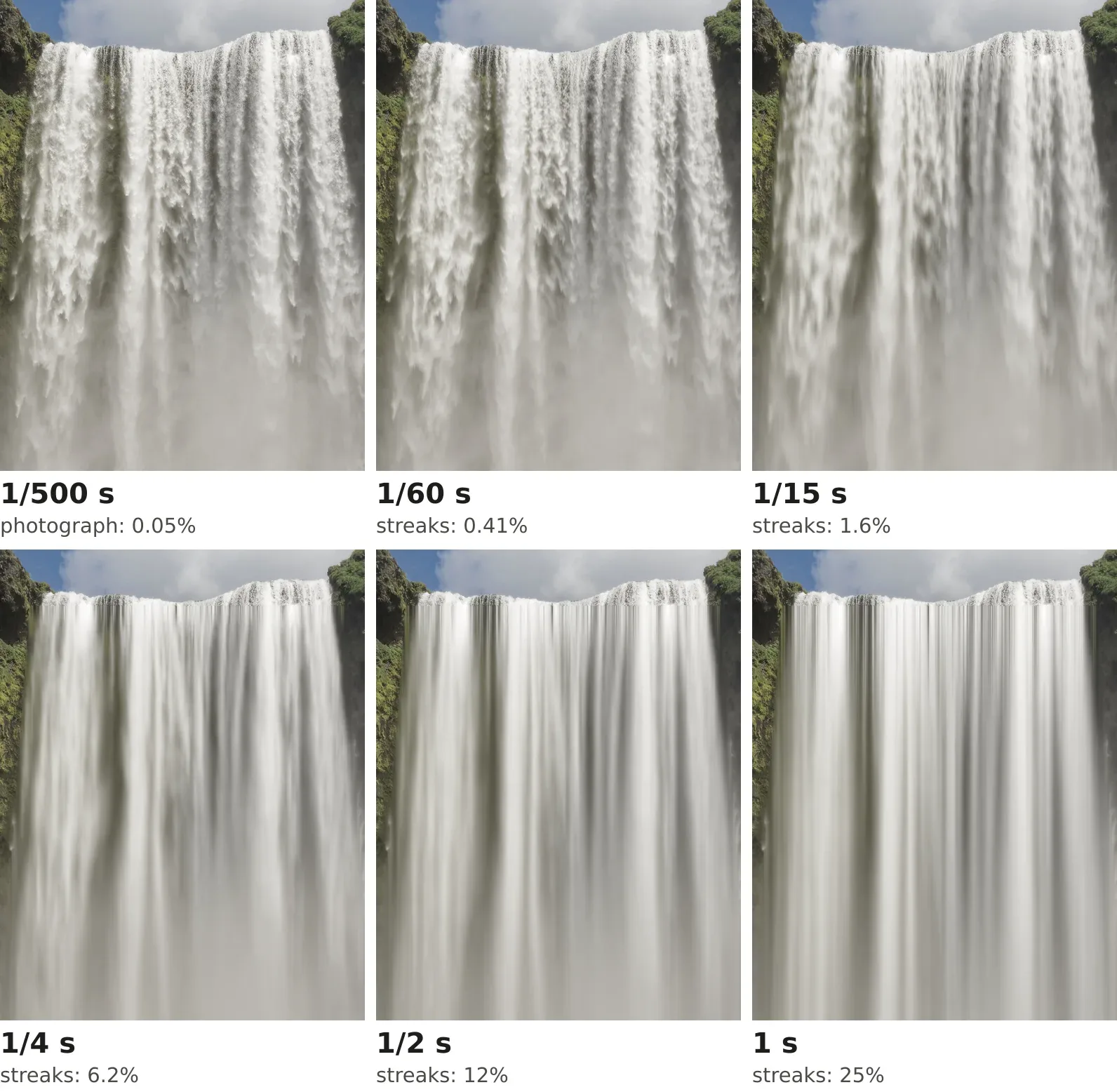
Simulation, not six photographs. Afterlight moved the water in Jakub Hałun's 1/500 s photograph of Skógafoss (CC BY 4.0) down the fall at free-fall speed and averaged it over each exposure time, in linear light. In the full photograph the 60 m drop spans about 61% of the frame's 98 m height; the crops show the upper part of the fall. Each percentage is the streak halfway down the drop as a share of the full frame's long side. The strip just below the lip is left as photographed, so it stays crisper than it would; the water there is slow, but not that slow. Real water also changes shape as it falls, which smooths long exposures more than this does. Cropped and resized; this adaptation keeps the photograph's licence.

Reading across the panels, with the streak lengths measured halfway down the fall:
- Up to about 1/1000 of the frame: frozen. The 1/500 s photograph streaks by 0.05%, and its clumps and droplets are crisp. This is the same allowance the motion-blur guide uses for a picture seen whole.
- About 1/1000 to 1/100: the water still reads as frozen, only softer. At 1/60 s the streaks are 0.4% of the frame.
- About 1/100 to 1/25: texture. At 1/15 s (1.6%) the water has become strands, and you can still see where it bunches and thins.
- About 1/25 to 1/10: long ropes. At 1/4 s (6%) the strands have joined into ropes, with a little texture left between them.
- About 1/10 or more: silk. At 1/2 s (12%) and 1 s (25%) the clumps are gone and only the lines of the main flows remain.
These bands are Afterlight's judgment, not a standard. They also match a real series. Peter West Carey photographed Snoqualmie Falls, an 82 m drop, at twelve shutter speeds from 1/8000 to 2.5 s for Digital Photography School, with a Canon 7D at 40 mm. Its frame covers roughly 100 to 120 m of height. Halfway down that fall, 1/30 s streaks the water by about 1% of the frame, and the picture still shows clumps. Of 1/10 s (2 to 3%), Carey wrote that his "normal favorite shooting speed of 1/10th of a second doesn't cut it here": "The water is blurred, but not enough for my liking." By 1/2 s (12 to 14%) the fall is smooth.
Shutter speeds for common waterfall scenes
To work out the crossing time for any framing, divide the size of the scene your frame covers at the fall by the water's speed. The water's speed after a drop of h metres is about 4.4 × √h m/s (see the table above). The scene size, along the frame's long side, is about distance × 36 ÷ focal length on full frame, or distance × 23.5 ÷ focal length on APS-C. Use the long side whichever way you hold the camera: it is only a yardstick for how big the streak looks in the picture.
These are worked examples on full frame, using the free-fall speed halfway down the stretch of fall in the frame. Each speed is rounded to a standard setting: faster for the freeze and the fast end of texture, slower for the slow end of texture and for silk. Speeds between the texture and silk columns give long ropes.
| Scene | Crossing time | Frozen | Texture | Silk |
|---|---|---|---|---|
| Forest cascade, a 1 m step, from 5 m at 35 mm (frame 5.1 m, water 3.1 m/s) | 1.6 s | 1/640 | 1/80 to 1/15 | 1/6 s |
| 5 m fall framed whole, from 10 m at 50 mm (frame 7.2 m, water 7.0 m/s) | 1.0 s | 1/1000 | 1/100 to 1/20 | 1/8 s |
| The same 5 m fall in a wide scene, at 16 mm (frame 23 m) | 3.2 s | 1/320 | 1/40 to 1/6 | 1/3 s |
| 30 m fall framed whole, from 60 m at 50 mm (frame 43 m, water 17 m/s) | 2.5 s | 1/400 | 1/40 to 1/8 | 1/3 s |
| The same 30 m fall, its lowest 11 m at 200 mm (frame 11 m, water 22 m/s) | 0.49 s | 1/2500 | 1/250 to 1/50 | 1/20 s |
| Skógafoss, 60 m, framed whole from about 114 m at 42 mm (frame 98 m, water 24 m/s) | 4.0 s | 1/250 | 1/25 to 1/6 | 1/2 s |
Calculated, not measured. Crossing time = frame ÷ water speed, with frame = distance × 36 ÷ focal length. If the lower part of the fall is what matters, use the speed there: it is faster, so the frozen limit gets stricter and silk comes sooner.
If you will look at the picture at 100% or crop it hard, divide by 3,000 instead of 1,000 for the freeze, for the reasons the motion-blur guide gives. Silk and texture don't change much with viewing size, because they are about the shape of the streaks rather than their sharpness.
Why the same shutter speed looks different at 16 mm and at 200 mm
Zooming in shrinks the frame but not the water's speed, so the water crosses the frame sooner and every look needs a faster shutter. Peter Dam noticed this photographing water pouring off sea stacks with a 200 mm lens: "At 200mm, 1/4s might be a complete blur… However, at 16mm… it might still look relatively frozen" (Adorama).
The numbers bear that out. Take the 30 m fall from the table, photographed from 60 m. At 200 mm on its lowest 11 m, 1/4 s streaks the water by about half the frame: complete blur. At 16 mm, the frame covers 135 m and the same 1/4 s streaks the water by about 3% of it: texture.
The same arithmetic qualifies a common rule of thumb, that big falls need shorter exposures than small ones. If silk is a fixed share of the frame, as the bands above assume, then framed whole a taller fall needs a longer exposure for silk. Its frame grows in proportion to its height, while its water speeds up only with the square root of the height. That is why the 5 m fall in the table goes silky at 1/8 s and Skógafoss needs 1/2 s. It is a prediction of the model, but Carey's series bears it out: at Snoqualmie his usual 1/10 s "doesn't cut it". A big fall goes silky at 1/30 or 1/15 s only when you frame a small part of it.
The other half of the rule is right for a different reason. Genkin's example of a stream that needs something like 10 seconds is "small streams with slow water": the slowness of the water matters, not the size of the fall. A stream moving at half a metre per second across a 5 m frame has a crossing time of 10 seconds, so silk takes a second or more.
Thin falls and cascades move slower than the table says
Free fall is a ceiling. Air pushes back on falling water, and it slows small pieces far more than large ones, because a drop has a lot of surface for its weight. The largest stable raindrops stop accelerating at about 9 m/s, in Gunn and Kinzer's laboratory measurements, the reference values for drop fall speeds. Without air resistance, water would reach that speed after a drop of about 4 m; with it, a drop takes much farther to get close.
So the table is likely closer for a thick, heavy flow than for a thin ribbon that breaks into spray, though even big falls fill with air and spray as they drop, and no one has measured how much that slows them. The look bands above were set using free-fall speeds, so some of that error is already built into them. Carey made the same distinction at Snoqualmie: a moderate flow "has enough volume to pick up speed toward the bottom without fanning out and drifting off as mist". For a thin, wispy fall, don't count on the water moving much faster than 10 m/s below its first few metres. Its crossing time is then longer, and so is every shutter speed you need.
Water that slides down rock instead of falling free is slowed by friction, and the free-fall formula doesn't apply. Time it instead. Watch a patch of foam travel a stretch whose length you can judge, such as a rock slab, and divide the distance by the time: foam crossing a 2 m slab in one second is moving at 2 m/s. Then use the crossing-time divisions as before.
How to get a slow enough shutter speed in daylight
The slow speeds that silk needs usually need less light than a bright day offers. Count the stops between the speed your meter gives and the one you want, and remove that much light. Each halving of the shutter time is one stop: if the meter gives 1/60 s at ISO 100 and f/11, a 1/2 s exposure is five stops slower, so it needs a filter of about five stops, or a darker moment.
- A neutral density filter takes the stops away without changing anything else. It is the only clean way to take away several stops.
- Stopping down gives a stop or two, but past about f/11 on full frame it costs fine detail to diffraction, as our guide to f/16 explains. Use it for the last stop, not the first five.
- The lowest ISO gives whatever room is left, often a stop at most.
- Shade and dusk do the same job for free. Falls in forest shade are often dark enough without a filter.
Then hold the camera still. At these speeds the rocks and trees must stay sharp for the water's softness to read as motion, so use a tripod and a self-timer or remote. If the whole frame is soft, our guide to why photos look soft shows how to tell camera shake from water movement. Check the front of the lens between frames, too: spray on the glass blurs the picture in a way no shutter speed can fix.
How this answer was made: AI-assisted calculation and writing. The water speeds are free-fall speeds from the drop height, and the crossing times use a frame size of distance × 36 ÷ focal length for a full-frame sensor. The look bands are Afterlight's judgment from the simulation above, checked against Peter West Carey's twelve-speed Snoqualmie Falls series, for which we estimated the frame size from the published height of the fall. The simulation uses the commonly published 60 m height of Skógafoss. Afterlight did not photograph a waterfall for this answer.
← All answersAfterlight