Answers / Technique
How long can you expose before stars start to trail?
Desk-researched answer
Short answer
The longest exposure depends on how closely the picture will be looked at, and the two famous rules answer for two different looks. On a full-frame camera:
- Seen whole, on a screen, a phone or a normal print: 500 ÷ focal length in seconds, the 500 rule. 25 s at 20 mm, 20 s at 24 mm. On a crop sensor, multiply the focal length by the crop factor first.
- A large print seen close, a 4K screen, or a crop: the NPF rule, (35 × f-number + 30 × pixel pitch in micrometres) ÷ focal length. Pixel pitch is the sensor width in millimetres × 1,000 ÷ the pixels across it. At f/2.8 on a 45-megapixel camera that works out to about 230 ÷ focal length, roughly half the 500 rule: 11 s at 20 mm.
- Perfectly round stars at 100%: half the NPF time. 5.7 s at 20 mm on the same camera.
These times hold at the centre of the frame. Near the left and right edges of a wide-angle picture, stars move up to three times as fast. With any lens from 14 to 28 mm facing east, south or west, sharp stars from edge to edge need about 12 seconds for a picture seen whole and 5 to 6 seconds by the NPF standard on 45 megapixels. Aimed at the celestial pole, those limits rise to about 22 and 10 seconds.
Both rules come from the same arithmetic. They differ in one number: how long a trail they accept.
Star trails are motion blur with a known speed
Star trailing is motion blur from the Earth's rotation, and unlike a running dog the subject's speed is known exactly. The sky turns once every sidereal day of 86,164 seconds, which is 15.04 arcseconds per second. On the sensor, a star on the celestial equator near the centre of the frame moves at focal length ÷ 13,713 millimetres per second. That is 1.75 micrometres per second with a 24 mm lens.
Frédéric Michaud of the Société Astronomique du Havre, who devised the NPF rule, gives the same speed in his derivation of the rule. Every rule divides an acceptable trail length by that speed. The rules disagree only about the trail.
Afterlight's guide to motion blur finds a shutter speed by dividing the time the subject takes to cross the frame by a viewing number: 1,000 for a picture seen whole, about 2,000 for a large print or a crop, and more for a 100% view. The sky takes 5.7 hours to cross a 24 mm frame on full frame. Divide by 1,000 and you get 20.6 seconds. The 500 rule gives 500 ÷ 24, or 20.8 seconds.
What the 500 rule and the NPF rule allow
The 500 rule allows a trail of a fixed share of the frame. The NPF rule allows a trail as long as the star's own image, which is a few pixels. That is the whole difference.
| Rule | Trail it allows on full frame | Share of the frame width | The viewing it suits |
|---|---|---|---|
| 500 rule | 36 µm | 1/1000 | The whole picture on a screen or a normal print |
| NPF rule at f/2.8 | 15 to 20 µm (about 4 pixels on 45 MP) | about 1/2000 | A large print seen close, a 4K screen, a crop |
| NPF with round stars (half the NPF time) | 8 to 10 µm (about 2 pixels on 45 MP) | about 1/4000 | 100% on a high-resolution file |
Afterlight's calculation. The trail is the rule's time multiplied by the star's speed on the sensor; the NPF range covers 24- to 61-megapixel full-frame cameras.
The 500 rule's trail is the same for every lens, because the time falls as the speed rises. Its 36 µm is of the same order as the 0.029 mm circle of confusion behind depth-of-field scales, and Michaud shows the 500 rule can be justified that way: a trail no longer than the circle of confusion gives about 400 ÷ focal length for stars on the celestial equator and 560 for stars at 45° declination (the angle north or south of it), and 500 sits between. A rule built on the circle of confusion is a rule for the picture seen whole, as depth of field is.
The NPF rule works from the size of a star's image instead. Michaud adds the diffraction spot, which grows with the f-number, to two pixels for demosaicing and lens imperfections, and lets the star move by one of its own diameters, which he describes as slightly perceptible trailing (his rule page has a calculator). That is where the 35 × N and the 30 × pixel pitch come from. The trail it allows is about 1/2000 of the frame width, the motion-blur guide's standard for a large print or a crop. His full formula adds atmospheric turbulence, the declination and a tolerance factor: 1 lets a star move by half its diameter so it stays round, 2 by a whole diameter, 3 by one and a half. The simple version leaves out turbulence, uses the factor 2 and assumes stars on the celestial equator. Halving the NPF time gives the round-star standard in the table above.
Michaud himself presents the NPF rule as the 500 rule's replacement. He calls the 500 rule very poor with fast lenses on full frame, recommends the simple NPF rule even for the web, social media and moderate prints, and concludes that the 500 rule "has had its day" (our translation), because people now crop, zoom in on screens, print large and above all expect perfectly sharp pictures.
Afterlight reads the arithmetic more narrowly. The two rules are not rivals: the 500 rule is right for a picture seen whole and the NPF rule is right for a picture inspected closely. Whether your pictures will be inspected closely is a judgment about how they will be viewed, and the safer choice when you don't know. For a picture that really will be seen whole, the 500 rule still holds at the centre of the frame.
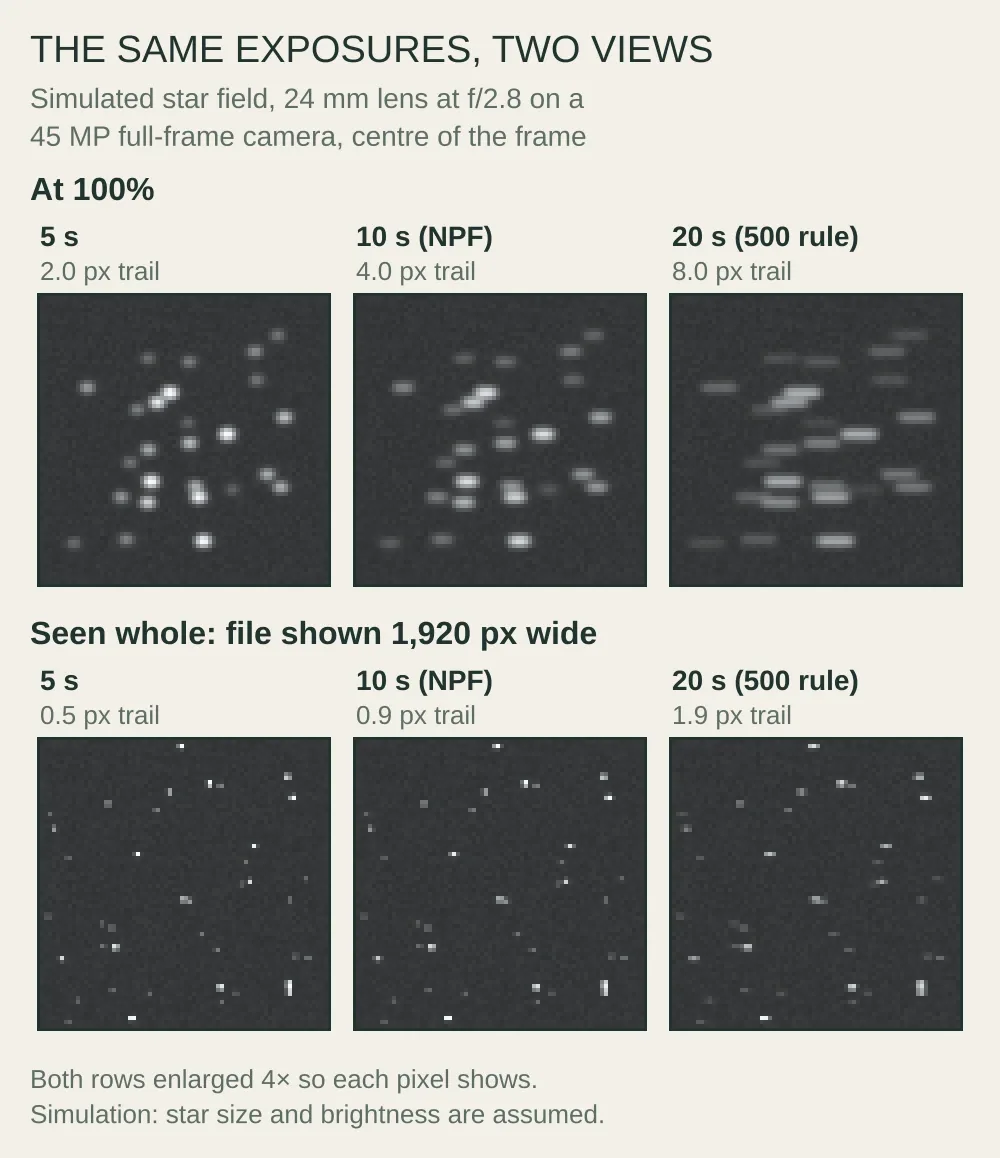
Simulation, not photographs. Each star is drawn as a soft spot 2.2 pixels wide, an assumption that decides how round the 10-second stars look, and smeared along a straight line by the trail the model predicts. The bottom row averages a wider field down by 4.3 times and shows fewer, brighter stars than a real sky so each stays visible. Real lenses add their own blur.
Longest exposure for common lenses and cameras
The longest exposure at the centre of the frame, at f/2.8, for the four standards:
| Lens (full frame) | Seen whole: 500 rule | NPF, 24 MP | NPF, 45 MP | NPF, 61 MP | Round stars at 100%, 45 MP |
|---|---|---|---|---|---|
| 14 mm | 35 s | 19 s | 16 s | 15 s | 8.2 s |
| 20 mm | 25 s | 13 s | 11 s | 10 s | 5.7 s |
| 24 mm | 20 s | 11 s | 9.5 s | 8.8 s | 4.8 s |
| 35 mm | 14 s | 7.9 s | 6.5 s | 6.0 s | 3.2 s |
Calculated, not measured, for stars on the celestial equator. Pixel pitches are 6.0, 4.36 and 3.79 µm, from 6,000, 8,256 and 9,504 pixels across 36 mm. Times of 10 seconds and over are rounded down to the whole second.
Four things follow from the table.
- Without a spec sheet, use a shortcut. At f/2.8 on full frame, the NPF rule comes to about 280 ÷ focal length on a 24-megapixel camera, 230 on 45 megapixels and 210 on 61 megapixels.
- Resolution only matters when you look closely. The 500 rule column is the same for every camera, because a picture seen whole hides the pixels. The NPF columns shorten as pixels shrink, but slowly: going from 24 to 61 megapixels costs about a quarter of the time, not half.
- Opening up still wins. At f/1.8 the diffraction spot is smaller, so the NPF times are about 15% shorter than at f/2.8 (16.3 s becomes 13.8 s at 14 mm on 45 MP). But f/1.8 collects 2.4 times the light per second, so 13.8 s at f/1.8 gathers twice the light of 16.3 s at f/2.8. Shoot as wide open as your lens draws clean stars.
- On a crop sensor, the two rules take different focal lengths. For the 500 rule, multiply the focal length by the crop factor: a 16 mm lens on a 1.5× APS-C camera gets 500 ÷ 24, or 20 s. For the NPF rule, use the real focal length and the camera's own pixel pitch: on a 26-megapixel APS-C sensor (3.77 µm pixels) at f/2.8, (35 × 2.8 + 30 × 3.77) ÷ 16 gives 13 s.
Wide-angle lenses trail fastest at the edges
The 500 and NPF rules give the time for the middle of the frame. A rectilinear wide-angle lens stretches the sky near the edges of the picture to keep straight lines straight. A star there is still a point, but its movement is stretched with the sky, so it trails faster than a star in the middle.
At the left and right edges of a full-frame picture, a star moving sideways crosses the sensor as fast as it would at the centre of a lens with a focal length of f + 324 ÷ f millimetres, where 324 is 18², the square of half the frame width. For a 14 mm lens that is 37 mm. For 20 mm it is 36 mm, and for 24 mm it is 37.5 mm. The sum is smallest at 18 mm, where it equals 36 mm. So in any frame that the celestial equator crosses, whatever wide lens you fit, the left and right edges trail about as fast as the middle of a 36 mm lens or faster. The top corners are faster still, because stars there also move at an angle; the formula slightly understates them.
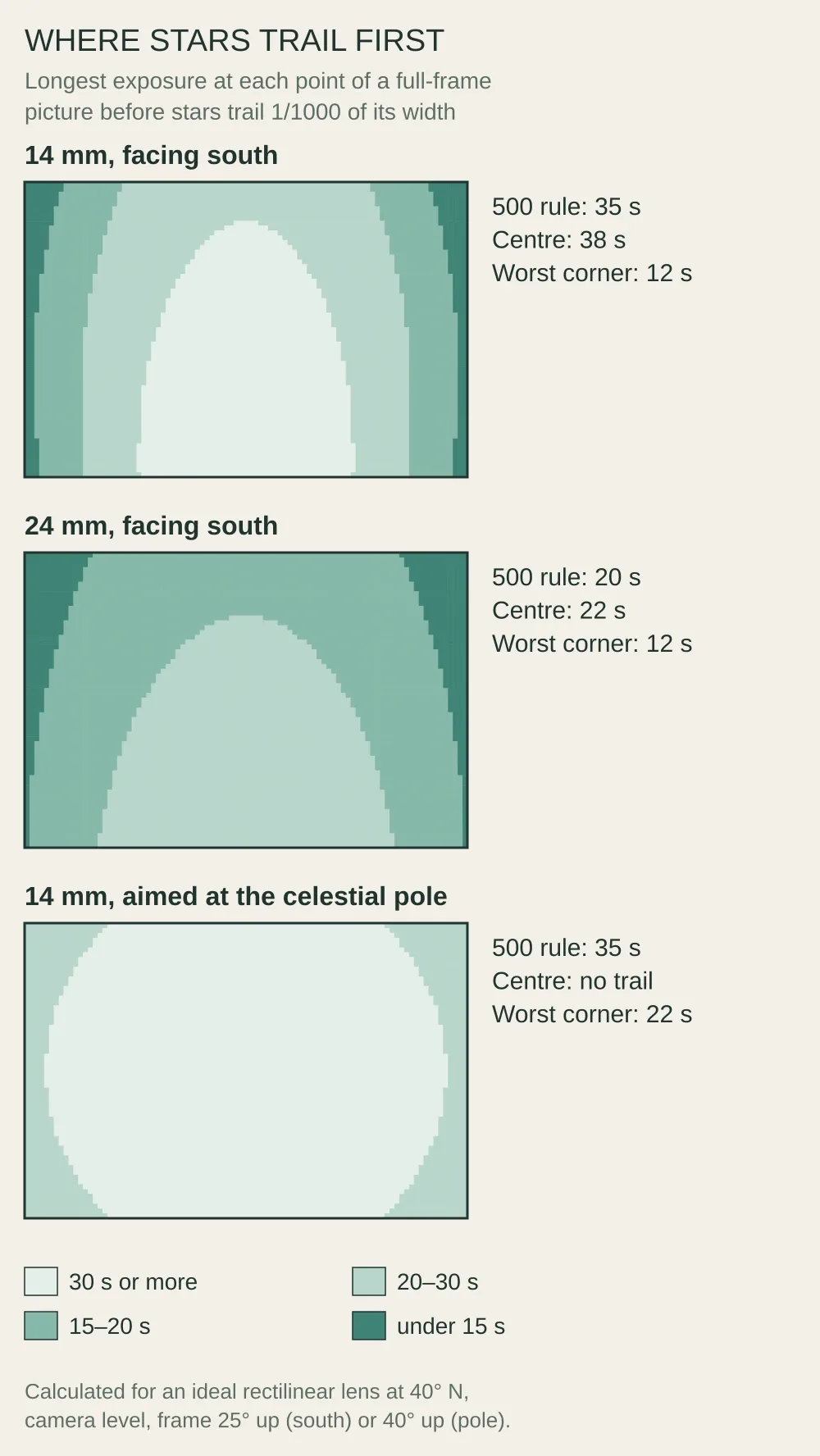
Original Afterlight calculation for an ideal rectilinear lens on a level camera at latitude 40° N, landscape orientation, framed 25° above the southern horizon (the Milky Way's core from mid-northern latitudes) or 40° up at the celestial pole. The centre of the south-facing frames sits about 25° south of the celestial equator, which is why the centre allows a little longer than the 500 rule. Lens distortion, atmospheric refraction and lens aberrations are not modelled.
Across the whole frame, the fastest stars in Afterlight's model set these limits for edge-to-edge sharpness:
| Lens, landscape, facing south | Fastest star, against the 500 rule's centre star | Seen whole, edge to edge | NPF at f/2.8 on 45 MP, edge to edge |
|---|---|---|---|
| 14 mm | 2.8× | 12 s | 5.8 s |
| 20 mm | 1.9× | 13 s | 6.0 s |
| 24 mm | 1.6× | 12 s | 5.9 s |
| 35 mm | 1.3× | 10 s | 5.1 s |
| 50 mm | 1.1× | 8.8 s | 4.1 s |
Calculated. Facing east at 20° up, the factors are slightly worse (3.2× at 14 mm).
Turning the camera to portrait helps. The left and right edges are then only 12 mm from the centre instead of 18 mm, so they are stretched less, and the edge-to-edge times seen whole rise to 14 to 16 seconds for 14 to 24 mm, up to about a quarter longer.
A simple way to remember it: facing east, south or west, the edges of any lens from 14 to 28 mm behave like the centre of a 40 mm lens. That gives 500 ÷ 40, or 12 seconds, for a picture seen whole, and about 230 ÷ 40, or 5.7 seconds, for the NPF standard on 45 megapixels, within half a second of the model's figures facing south (facing east, use 45 mm).
A 14 mm lens therefore buys long exposures only for the middle of the picture. For the edges, it gives no more time than a 24 mm lens. That doesn't make the 500 rule useless with an ultra-wide: the edges of a Milky Way picture are often foreground, and many fast wide-angle lenses smear stars in the corners anyway, through coma and astigmatism, so a little extra trailing there is hidden. But if you print large and want sharp stars in the top corners, plan for the edge times, shoot in portrait, or keep the important sky away from the sides.
Pointing away from the celestial equator buys time
Stars away from the celestial equator move more slowly: a star at declination δ, its angle north or south of the equator, moves at cos δ of the equator's speed. The NPF rule's full version divides by cos δ for this, where δ is the lowest declination anywhere in the frame:
| Lowest declination in the frame | 0° | 30° | 45° | 60° |
|---|---|---|---|---|
| Multiply the centre time by | 1 | 1.15 | 1.41 | 2 |
The catch is the word anywhere. The celestial equator rises due east, sets due west and crosses the southern sky (the northern sky, if you live south of the Equator) at an altitude of 90° minus your latitude. From 40° N it passes 50° above the southern horizon. A wide frame facing east, south or west almost always contains it, so use 0°. In Afterlight's model, every frame from 14 to 50 mm framed 25° above the southern horizon from 40° N, where the Milky Way's core rises, reached within 11° of the equator. The core itself sits at about −29°, but entering −29° would credit the whole frame with the core's slower motion.
The factor is exact for stars near the centre of the frame. With wide-angle lenses it overstates the time at the edges, more the wider the lens, because it leaves out the edge stretch above: for a 14 mm lens aimed at the celestial pole from 40° N, the lowest declination in the frame is 33° and the factor suggests 42 seconds, but the corners reach the seen-whole limit at 22.
Aiming north (south, in the southern hemisphere) at the celestial pole is the one direction where the edge limit no longer depends on the lens. With the pole at the centre of the frame, the picture simply rotates about its centre, and a star's speed on the sensor is its distance from the centre multiplied by the rotation rate, whatever the focal length. The corners of a full-frame sensor, 21.6 mm from the centre, move 1.6 µm per second with a 14 mm lens and with a 200 mm lens alike. So with the pole centred:
- Seen whole, edge to edge: about 22 seconds with any lens.
- NPF at f/2.8 on 45 megapixels, edge to edge: about 10 seconds with any lens.
When the exposure is too short for a clean picture
The rules set a ceiling on the shutter time; they don't promise enough light. If the time you can use leaves the stars too faint or the picture too noisy, there are three ways forward.
- Accept the looser standard. If the picture will be seen whole, the 500 rule is honest for the middle of the frame. Don't shorten the exposure for a 100% view nobody will make.
- Gather more light, or brighten later. Open the aperture as far as the lens draws clean stars. Then raise ISO in camera or brighten the raw file afterwards; Afterlight's guide to raising ISO or brightening later covers which to choose once the shutter time is fixed.
- Stack or track. Several short frames, aligned on the stars in stacking software and then averaged, reduce noise much as a longer exposure would, without the trailing. Averaged without that alignment, they add their trails together. A star tracker turns the camera with the sky and removes the limit for the sky, at the cost of blurring a fixed foreground, which then needs its own frame.
Check the first frame at the centre and the corners
Magnify the first frame on the camera's screen to match how the picture will be seen, first at the centre and then in a top corner. On a 45-megapixel file, view at about 25% for a picture seen whole, 50% for the NPF standard and 100% for round stars; at the right magnification, an acceptable trail is about 2 pixels.
- Stars are short lines at the centre at that magnification: the exposure is too long for the viewing you planned. Shorten it. Lines that only show at a closer magnification than you planned are not a problem.
- Stars are round at the centre but smeared at the edges: take a test frame at 1 or 2 seconds. If the corner stars stay smeared, the cause is the lens (coma, astigmatism or a tilted focus plane), not the sky's motion, and a shorter exposure won't fix it; stopping down a third of a stop to a stop often helps. If the short frame shows clean points, it is trailing: use the edge-to-edge times above.
- Everything, foreground included, is doubled or soft in one direction: the camera moved. Our guide to why photos look soft shows how to tell shake from motion and focus.
How this answer was made: desk research and calculation, AI-assisted. The NPF rule and its assumptions come from Frédéric Michaud's own explanation, linked above; the viewing standards come from Afterlight's motion-blur guide. The tables and both figures come from Afterlight's model in editorial/tests/star-trail-exposure-model: an ideal rectilinear lens on a full-frame sensor, the sidereal rotation rate, and no refraction, lens distortion or aberrations. No night photographs were taken for this answer; the star crops are simulations.