Answers / Technique
What aperture should I use for a group photo?
Editorial explanation
Short answer
Use the f-number that covers the depth from the front-row faces to the back-row faces at your framing, not a fixed f/8. On full frame, that is roughly 45 × depth ÷ frame width², with both in metres and focus placed just in front of the middle of the group. Frame width is the width of the scene your frame covers at the group: about distance × 36 ÷ focal length. Use 30 instead of 45 on APS-C. If you focus on a front-row face rather than between the rows, double the result, and round up one more stop if you rely on autofocus. A two-row family framed 2.5 m wide needs f/3.5 with focus between the rows, or about f/7.1 when autofocus lands on a front-row face. Three rows of ten framed 6 m wide are covered at f/1.4 for depth alone. For a group that size, f/5.6 to f/8 is about edge sharpness, not depth: use the aperture where your lens is sharp to the corners. Then zoom into the faces at the ends of the back row before anyone leaves.
That standard is strict on purpose. Everyone in a group photograph zooms in on their own face, so the numbers here keep each face sharp at a 100% view of a 24-megapixel file, not only in the whole picture.
Why the head count doesn't set the aperture
The aperture a group needs depends on two measurements: how deep the group is from front faces to back faces, and how wide the frame is at the group. The number of people only matters through those two.
Depth is the obvious one. People standing side by side in one straight row share a single focus distance, so even f/2 keeps them all sharp. Every row added behind them adds depth the aperture has to cover.
Frame width matters more, because it enters squared. A wider frame means a smaller image of the group on the sensor, and the blur from a face that sits off the focus distance shrinks with the square of that reduction. ZEISS's paper on depth of field makes the same point from the lens side: depth of field grows with the square of the focus distance (page 7), and at the same framing it is almost independent of focal length (page 5). So a 35 mm lens at 3.9 m and an 85 mm lens at 9.5 m, framing the same 4 m wide group, need the same f-number. Doubling the frame width cuts the f-number needed to a quarter.
That is why the common advice (f/4 for groups two people deep, f/5.6 for three and f/7.1 for four in Click Love Grow's guide; "f/5.6, f/8 or smaller apertures" and "the more rows, the smaller the aperture" in Dbackdrop's tips) is safe for big groups but sometimes wrong for small ones. A large group in a wide frame needs very little. A small, deep group photographed close needs more than f/8.
Smallest f-number for a group photo, by depth and frame width
The table gives the smallest f-number that keeps every face sharp on full frame, with focus placed at the balance point described in the next section. Read across from the width your frame covers at the group, and down from the depth between the front-row and back-row faces.
| Frame width at the group | Camera distance with a 50 mm lens | 0.5 m deep (about two rows) | 1.0 m deep (about three rows) | 1.5 m deep (about four rows) |
|---|---|---|---|---|
| 2 m | 2.8 m | f/5.5 | f/10.7 | beyond reach (f/15.5) |
| 2.5 m | 3.5 m | f/3.5 | f/7.0 | f/10.2 |
| 3 m | 4.2 m | f/2.5 | f/4.9 | f/7.2 |
| 4 m | 5.6 m | f/1.4 | f/2.8 | f/4.1 |
| 6 m | 8.4 m | below f/1.4 | below f/1.4 | f/1.8 |
| 10 m | 13.9 m | below f/1.4 | below f/1.4 | below f/1.4 |
Calculated for an ideal lens, not measured. Round up to the next marked aperture, and one more stop if you rely on autofocus, because people shift and focus rarely lands exactly on the balance point. If you focus on a face in the front or back row instead of the balance point, double the f-number. "Beyond reach" means diffraction alone would exceed the standard; reduce the depth or frame looser. The row depths assume roughly half a metre between rows of standing adults, face to face; a seated front row with chairs usually adds more. Pace your own group out.
Frame width comes from distance and focal length: on full frame it is about distance × 36 ÷ focal length. A 50 mm lens at 4.2 m covers about 3 m. Use the long side of the frame, whichever way you hold the camera.
The rule of thumb in the short answer comes from the same geometry. On a full-frame sensor, a face that sits a distance Δ from the focus plane blurs to a spot of about Δ × 36² ÷ (N × frame width²), with Δ and the frame width in millimetres. Setting that spot to 0.0144 mm, and Δ to half the group's depth, gives N ≈ 45 × depth ÷ width², with depth and width in metres. It slightly overestimates the exact figures in the table, which is the safe direction. For other formats the constant scales with the square of the sensor width over the circle of confusion: about 30 for 1.5× APS-C (28 for Canon's 1.6×) and 21 for Micro Four Thirds.
Above about f/11 on full frame, the table is asking for something stopping down cannot deliver. Diffraction alone then spreads each point about as wide as this standard allows: the ideal Airy disk at f/11 is about 0.015 mm across in green light. Close the gaps between the rows or frame looser instead.
How sharp a group photo needs to be
Depth-of-field calculators usually allow a blur spot of 1/1500 of the frame diagonal, about 0.03 mm on full frame. ZEISS explains that this gives satisfying sharpness for a whole print viewed at a normal distance, that 1/3000 of the diagonal is the strictest requirement worth setting for such viewing, and that the usual 1/1500 standard can no longer meet expectations once you make cropped enlargements (page 19 of the ZEISS paper).
A group photograph is a cropped enlargement for almost everyone who looks at it, because each person zooms in to find themselves. The table and the rule of thumb therefore use 1/3000 of the diagonal, the 1/1500 standard applied to a 2× crop: 0.0144 mm on full frame, or about 2.4 pixels on a 24-megapixel full-frame sensor, which keeps faces sharp at a 100% view of such a file. If the picture will only be seen whole, on a wall or in a slideshow, the conventional 1/1500 standard is enough and every f-number above halves.
Where to focus in a group photo
Focus a little in front of the middle of the group, not one third of the way in. For a group whose depth is small compared with its distance from the camera, that means the middle.
The focus distance that blurs the front and back rows equally is the harmonic mean of their distances: 2 × front × back ÷ (front + back). ZEISS gives the same relationship for the near and far limits of depth of field (page 15). As a share of the group's depth, the balance point sits 1 ÷ (2 + k) of the way back from the front row, where k is the group's depth divided by the front row's distance. A group 1 m deep with its front row at 5 m has k = 0.2, so the balance point is 45% of the way in. The point reaches one third only when k = 1, with the back row twice as far away as the front row. That is a landscape with a near foreground, not a group photograph.
The one-third rule still appears in group-photo advice from PictureCorrect and in the US Navy basic photography course reproduced on DOFMaster. ZEISS calls it "not generally true" and notes that depth of field is more symmetrical at shorter distances. Focusing one third in costs about half a stop. The bigger loss comes with two rows: the balance point is a gap with no face in it, so autofocus lands on a front-row face and the f-number needed doubles.
How to place focus in practice:
- Three or more rows: use a single autofocus point on a face in the middle row, near the centre of the frame. That is close enough to the balance point.
- Two rows: focus on a front-row face and use double the table's f-number, because the back row now carries all the blur. Alternatively, have the back row stand close enough that their faces fill the gaps between the front row's heads, which shrinks the depth to cover.
- Face detection: it may pick any face in the group. Choose the face yourself.
Don't curve the group to keep everyone the same distance away
A straight row parallel to the camera is already at one focus distance. Curving the row so everyone stands the same distance from the camera moves the ends off the focus plane.
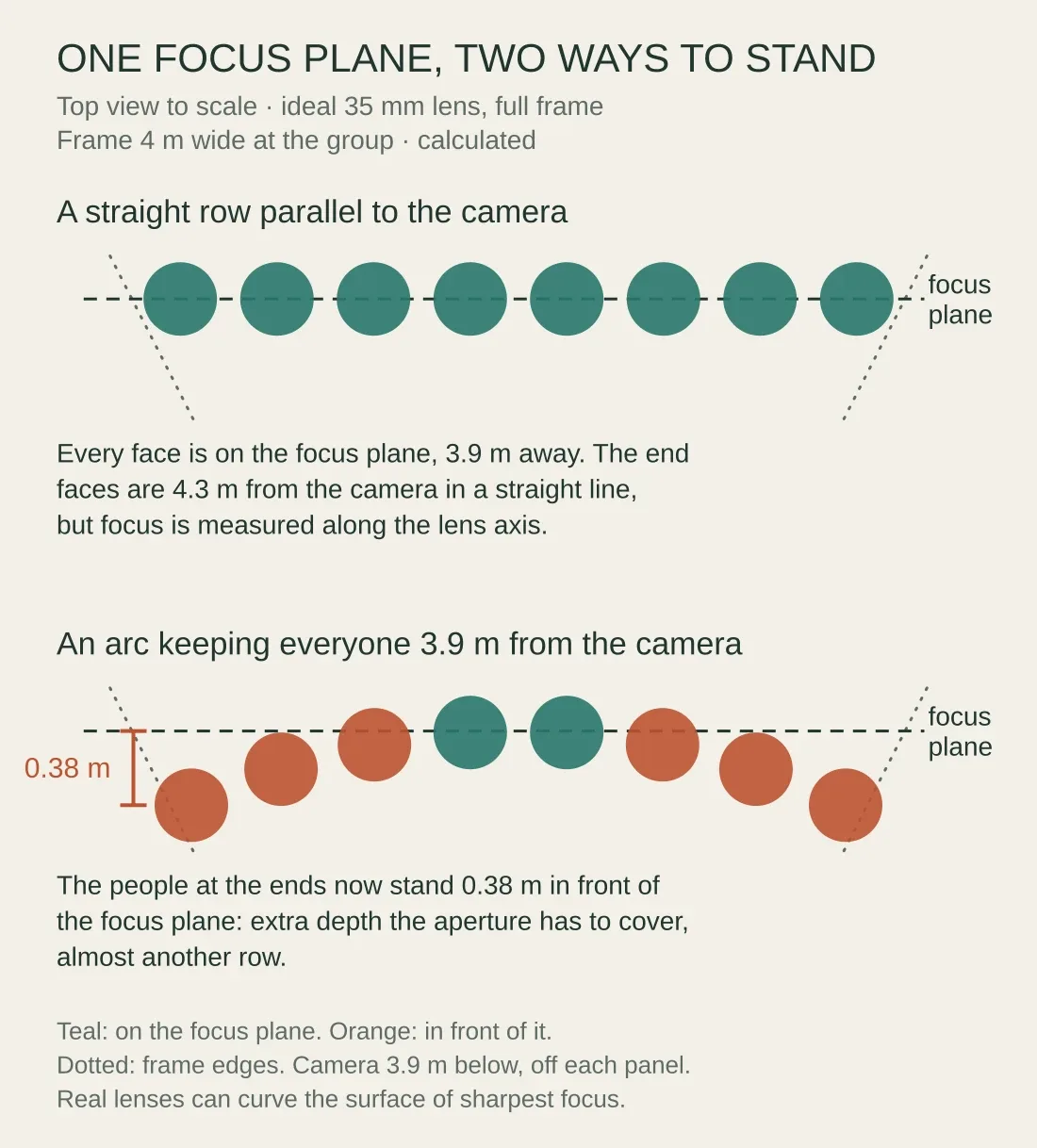
Original Afterlight diagram, calculated for an ideal 35 mm lens on full frame framing a 4 m wide group; not a photograph.
A camera focuses on a plane parallel to the sensor, the focal plane that ZEISS describes as the image of the sensor surface in front of the lens (page 7). The people at the ends of a straight row are farther from the camera in a straight line (4.3 m against 3.9 m in the diagram) but at exactly the same focus distance. PictureCorrect's guide confuses straight-line distance with focus distance: it says the people at the sides of a straight row are "farther away from the camera" and advises arching the row "in an arc of a circle" so that "all of them will now be at the same distance from your camera". In the diagram, that arc brings the end people 0.38 m in front of the focus plane, close to the depth of another row. Where the arc meets the frame edges, the offset is 0.43 m in this example, and about 1.3 m with a 24 mm lens framing a 10 m wide group.
If you curve a row for the composition, count the curve as part of the group's depth.
Make the group shallower before you stop down
Each stop you don't need costs light. Going from f/4 to f/8 is two stops: at the same shutter speed, that is ISO 1600 instead of 400, or four times the flash power at the same distance. Afterlight's guide to raising ISO covers what that ISO increase costs in the file.
Reducing the depth does the same job for free:
- Close the gaps between rows, and have the back row lean forward slightly and the front row lean back, as PictureCorrect suggests.
- Move a seated front row's chairs closer to the standing row behind it.
- Step back and frame a little looser if you have pixels to spare. The f-number needed falls with the square of the frame width, although cropping back to a tight frame afterwards recovers only part of that gain.
When depth really is missing, the trade works like any other depth-of-field decision. The f/16 guide explains how to weigh extra depth against diffraction and shutter speed.
Check the back corners before the group breaks up
After the first frame, magnify playback on the faces at both ends of the back row, then the front row. Those faces are where three problems meet: they are the farthest from the focus point in depth, they sit near the frame edges where many lenses are weakest, and they are where field curvature shows.
Real lenses rarely focus on a perfectly flat plane. Lensrentals' measurements of fast 35 mm lenses found surfaces of sharpest focus that curve away from a flat plane across the frame, and that "stopping down a lens doesn't flatten the field"; you have to stop down until depth of field exceeds the curvature, which for those lenses meant at least f/8 (Roger Cicala, "Field Curvature and Stopping Down"). A group that the table covers at f/2 may still lose its end faces with a fast wide-angle near its widest aperture.
Read what the playback shows:
- The whole back row is soft: focus landed too far forward, or the depth is greater than you estimated. Refocus at the balance point or stop down one stop.
- Only the end faces are soft: suspect field curvature or edge softness. Stop down one stop, or move the end people in from the frame edges.
- Everyone is soft in the same direction: that is movement, not depth. Afterlight's guide to why photos look soft shows how to tell motion blur from defocus.
How this answer was made: AI-assisted calculation and writing. The f-numbers come from the ideal thin-lens blur formula with focus at the harmonic mean of the front and back rows, a 36 × 24 mm sensor and a blur limit of 1/3000 of the diagonal (0.0144 mm). Lens aberrations, field curvature, focus error and subject movement are not modelled. No photographs were taken for this answer.
← All answersAfterlight