Answers / Camera Basics
Is a teleconverter better than cropping?
Desk-researched answer
Short answer
A 2× converter on a good lens usually beats cropping clearly; a 1.4× is close to a tie unless the lens is exceptionally sharp. A converter magnifies the lens's blur as much as the subject, so all it adds over a crop is more pixels across the subject, and those pay only where the lens out-resolves the sensor. Working from Photography Life's lab measurements on a 45-megapixel Nikon Z7, Nikon's 2× converter beat a matching crop by 30% on the very sharp Z 70-200mm f/2.8 and by 15% on the Z 100-400mm at 400mm; the 1.4× ranged from 8% ahead to 6% behind. The lost stop costs autofocus speed in low light, not image noise. Buy a converter made for a lens that is sharp wide open at its long end; otherwise crop.
A teleconverter adds pixels, which help only if the lens out-resolves them
A teleconverter sits between lens and camera and magnifies the middle of the image the lens projects, by 1.4× or 2×. It magnifies everything in that image: the subject, the lens's aberrations, its diffraction blur, camera shake and the shimmer of warm air. Cropping the bare frame to the same view and enlarging it magnifies all of those by the same amount.
So against a crop, a converter changes one thing. The subject lands on more pixels: 1.4 or 2 times as many across, about 2 or 4 times as many in area. On a 45.7-megapixel Nikon Z7 (8256 × 5504 pixels), a crop to the 1.4× view keeps about 23 megapixels and a crop to the 2× view about 11; the converter frame keeps all 45.7. The arithmetic of what a crop keeps is in Move Closer, Zoom In, or Crop?.
Those extra pixels add detail only if the lens delivers detail finer than the bare sensor could record. A sensor records at most one line pair across two pixels, about 115 line pairs per millimetre on the Z7's 4.35-micron pixels. If the lens resolves well beyond that, a crop throws real detail away and the converter recovers it. If the lens's blur already spreads across several pixels, more pixels sample the same blur more finely and the picture looks no sharper.
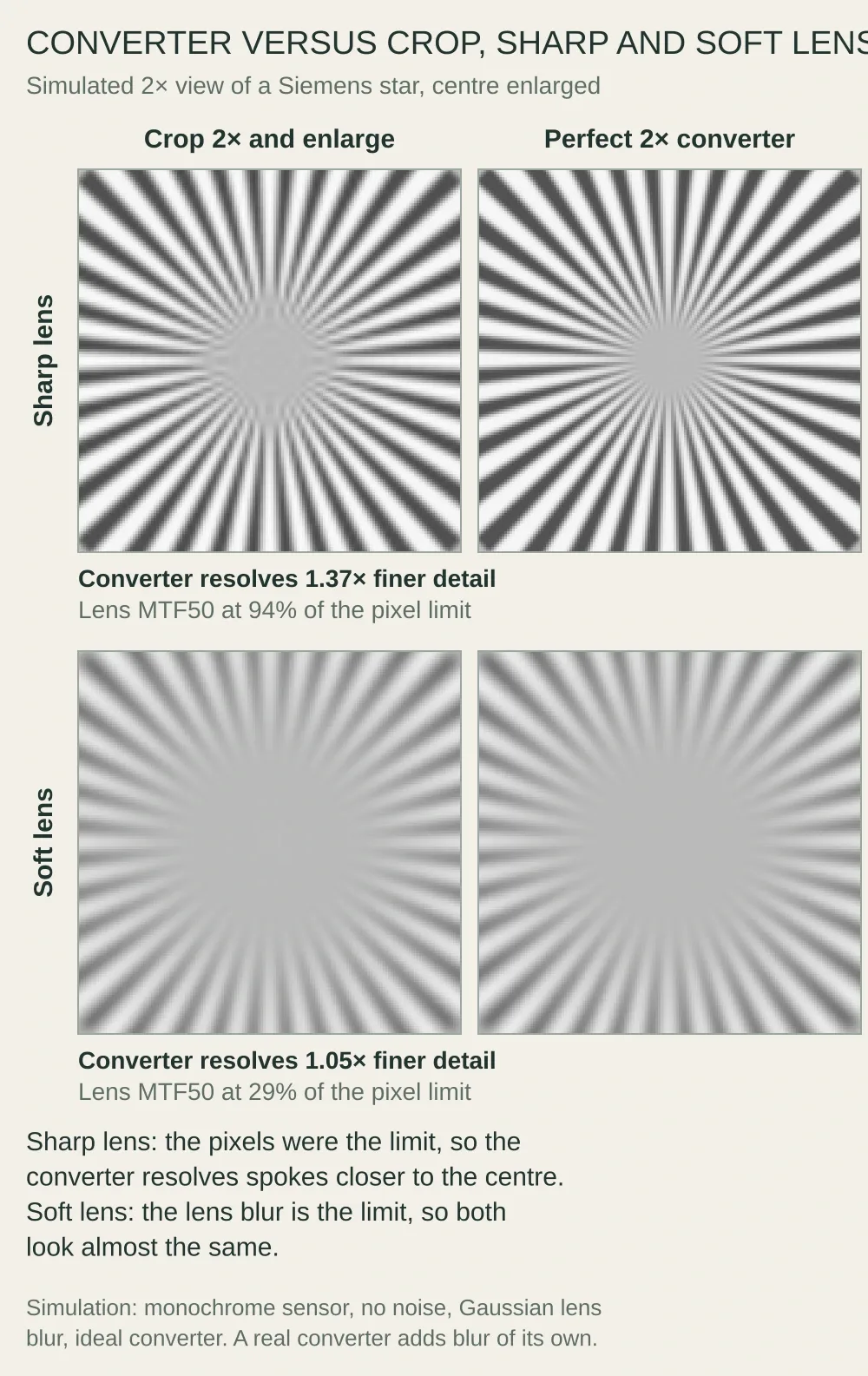
Original simulation, not photographs: a monochrome sensor with no noise, Gaussian lens blur, and a perfect converter that adds no blur of its own. A real converter does, so real gains are smaller.
So the common warning that a converter "magnifies the flaws of the lens" points the wrong way when the alternative is cropping: the crop magnifies them just as much. What the converter adds against a crop is its own glass, and the pixel gain has to outweigh that. It is the same distinction our Answer on crop sensors and reach draws between tighter framing and real detail.
What lab measurements show for 1.4× and 2× converters
Photography Life measured both Nikon Z converters on two lenses with Imatest on a 45.7-megapixel Nikon Z7, reporting MTF50 in line widths per picture height: a standard lab sharpness score, roughly how many alternating black and white lines can be told apart across the frame's height, so higher means finer detail (Photography Life, 2023; method). Their charts include the bare lenses, so the crop can be worked out: cropping to a converter's view keeps 1/1.4 or 1/2 of the picture height at the same detail per millimetre, so the cropped frame resolves the bare figure divided by 1.4 or 2. Enlarging it afterwards adds no recorded detail, so this is the best case for cropping. As a rough guide, MTF50 differences under about 10% are hard to see in a photograph.
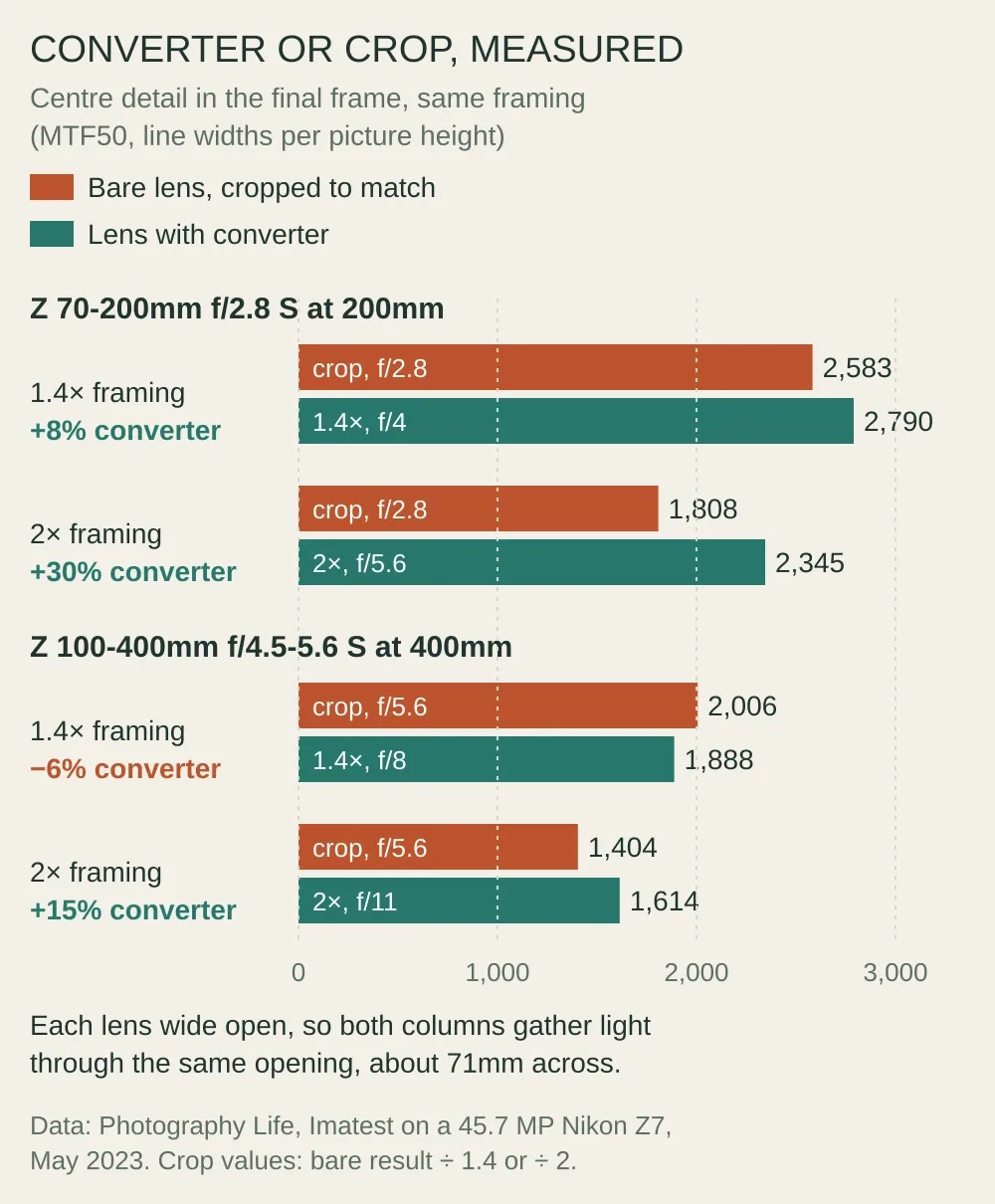
Original chart: Afterlight's crop calculation from Photography Life's published centre measurements. Each lens is wide open, so bare lens and converter gather light through the same opening, about 71mm across (200mm ÷ 2.8, 280mm ÷ 4, 400mm ÷ 5.6), and the comparison is like for like.
| Lens, centre, wide open | Crop to 1.4× | 1.4× converter | Crop to 2× | 2× converter |
|---|---|---|---|---|
| Z 70-200mm f/2.8 VR S at 200mm | 2,583 | 2,790 (+8%) | 1,808 | 2,345 (+30%) |
| Z 100-400mm f/4.5-5.6 VR S at 400mm | 2,006 | 1,888 (−6%) | 1,404 | 1,614 (+15%) |
Two things stand out.
- The 2× gains are the robust finding; the 1.4× results are close to a tie. A 2× crop throws away three quarters of the pixels and a 1.4× crop about half, so the bigger the crop you would otherwise make, the more a converter has to win back. That is why the 2× came out ahead on both lenses by a wide margin, even though it is the optically weaker converter. The 1.4× results, from 8% ahead to 6% behind, sit within what sharpening, test sessions and copy variation can move.
- The sharper lens gains more. Photography Life calls the 70-200mm "one of the sharpest lenses we've ever tested in the lab", and describes the 100-400mm as having "good sharpness at 400mm, but not record-setting". With the sharp lens the pixels were the limit, so both converters paid. With the 100-400mm wide open at f/5.6, the lens's own blur mattered more and the 1.4× had little to win back. Stopped down a stop, where the converter gets half the light of the wide-open bare lens, the 1.4× edges ahead on both lenses (2,923 at f/5.6 and 2,065 at f/11), which suits still subjects in good light.
Photography Life's own side-by-side photographs, made on the same Z7 with the 70-200mm at 200mm, point the same way: "the teleconverters both beat the bare lens, and the 2.0x teleconverter captures more subject detail than the 1.4x teleconverter" (Photography Life, 2023). These are one copy of each lens, measured at the centre only; the bare 70-200mm figures come from Photography Life's 2021 lens review on the same Z7. Photography Life tested three copies of each converter and found almost no difference between them.
Why published teleconverter tests disagree
Search for this question and you will find tests that crown the converter and tests that crown the crop. Read the equipment lists and they fit one pattern: a 2× converter on a sharp lens wins, a 1.4× is close either way, and a slow zoom at f/11, distant haze or missed focus erases the difference.
| Test | Body | Lens and converter | Result |
|---|---|---|---|
| Photography Life, 2023 | Nikon Z7, 45.7 MP | Z 70-200mm f/2.8 S and Z 100-400mm S, Nikon Z TC-1.4x and TC-2.0x | Converter ahead except the 1.4× on the 100-400mm wide open (above) |
| Cameralabs, 2020 | 45 MP Nikon | Z 70-200mm f/2.8 S, 1.4× cropped to 400mm versus 2× | 2× "a bit sharper in the center" than a cropped 1.4× frame, but "so close" that "you wouldn't see a difference" at normal viewing |
| West Lakes Images, 2023 | Nikon Z7 II, 45.7 MP | AF-S 500mm f/5.6 PF, Nikon TC-14E III and TC-20E III | 1.4×: no visible difference at 2.6 km, with "air turbulence effects", slight gain at 14 m; 2× "clearer" with "better contrast" |
| Ed Dozier, 2025 | Nikon Z9, 45.7 MP | AF-S 500mm f/5.6 PF, Sigma TC-1401 | Tie: 2,098 lines per picture height with the converter against 2,100 for the crop |
| B&H Explora, 2021 | Sony a7R IIIA, 42 MP | FE 200-600mm at 200mm, FE 2× | Crop "has an edge in terms of clarity" |
| Kevin Raposo via PetaPixel, 2022 | Canon EOS R6, 20 MP | Sigma 120-300mm f/2.8 Sports, 1.4× | Static: converter "slightly sharper"; football: bare lens sharper on average |
Off-brand converters cost corners and autofocus more than centre detail. The two 500mm tests used the same lens on 45.7-megapixel Nikon bodies. Dozier used a Sigma TC-1401, noting that "Sigma and Nikon both tell me not to do it", and measured no gain at 1.4×. West Lakes, with Nikon's own TC-14E III, saw no visible difference at 1.4× either on its 2.6 km target, where heat shimmer blurred both versions; at 14 m the converter kept fine cobweb detail that the crop was starting to lose. Dozier also found the converter worth using on his Nikon Z8, which has the same sensor as his Z9, so a single measurement can swing either way. Years earlier, Photography Life found an older Sigma 1.4× "about as good optically" as Nikon's in the centre of a Nikon lens but much worse toward the corners, and it confused the camera about the aperture and sent autofocus into a loop (Photography Life).
A slow zoom at f/11 has little to give. B&H's crop win came from a 2× converter on an f/5.6 zoom, an f/11 combination, and at 200mm, where the lens could simply have zoomed to 400mm.
Blur scores and action shots measure something else. Raposo scored frames with a blur-detection algorithm, not a resolution measurement. On static subjects the converter frames came out slightly sharper; over 3,000 football frames they averaged 0.60 against 0.51 without (lower is sharper), which he put down to autofocus. PetaPixel's headline summarised both as cropping being better.
Fewer megapixels leave more to win. A 24-megapixel full-frame sensor has pixels about 5.9 microns across, against 4.35 on a 45.7-megapixel one. A given lens blur is smaller relative to those larger pixels, so the pixels are more often the limit. A converter that only ties a crop on a 45-megapixel body has more to win on a 24-megapixel one, and less on a 61-megapixel one.
The lost stop costs autofocus speed in low light, not image noise
A 1.4× converter costs one stop and a 2× two stops, as Canon's extender guide puts it. But the f-number is focal length divided by the diameter of the lens opening, and a converter does not change that opening. A 400mm f/5.6 lens and the same lens as a 560mm f/8 both gather light through an opening about 71mm across, so at the same shutter speed the subject sends the same light into the camera either way. The converter spreads it over twice as many pixels, so the meter calls for one stop more ISO, but at the same print size the noise is close to equal. Thom Hogan makes the same point in terms of dynamic range, for a 1.4× converter against a 1.5× crop: "If you increase ISO by a stop because of the change in effective aperture with the teleconverter, you're about equal" (Z System User). The small exception is the deepest shadows, where each pixel's read noise counts and the crop, with fewer pixels, can be slightly cleaner.
In bright light, when the bare lens is already at base ISO and the subject allows a slower shutter speed, the converter can come out ahead. Slow the shutter by a stop at the same ISO and the converter frame gathers twice the light of the crop without clipping, because that light falls on twice the pixels; the bare lens cannot do the same without overexposing. Hogan: "If you keep ISO the same as the crop when using the teleconverter, you're better off."
The same equivalence settles three other worries:
- Diffraction. Diffraction blur grows with the f-number: the Airy disc is about 2.44 × wavelength × f-number across (Edmund Optics), about 7.5 microns at f/5.6 and 10.7 at f/8 in green light. The converter's image is also 1.4 times larger, so relative to the subject the blur is unchanged. The f/8 or f/11 a converter shows is not an extra diffraction penalty against a crop; the crop enlarges its own f/5.6 blur by the same factor.
- Camera shake and motion blur. At the same shutter speed, the subject moves the same share of the final frame either way, because the crop is enlarged just as much. A converter needs a faster shutter only compared with the uncropped bare frame. For the shutter speed itself, see the motion-blur guide.
- Depth of field and background blur. From the same position at the same framing, a crop of 400mm f/5.6 and a 560mm f/8 frame have matching depth of field, because both use the same opening. Our guide to sensor size works through the same equivalence.
What the narrower f-number does cost is autofocus speed, mostly in poor light. Canon notes that many DSLRs stop autofocusing when the maximum aperture drops below f/5.6, while newer ones still focus at f/8, and its EOS R mirrorless cameras can focus at f/22 (Canon). Hogan sees little slowdown on mirrorless bodies, having used f/11 "without seeing any real degradation of focus". Photography Life timed slower focusing with both Nikon Z converters and found the 100-400mm at f/8 and f/11 "simply isn't enough to focus quickly in low light"; its rule of thumb is to "keep the overall maximum aperture around f/6.3 or brighter, although f/8 or f/9 is still workable" (Photography Life, 2023; verdict).
What else a converter costs
- Compatibility. Converters fit only listed lenses. Canon's RF 100-500mm accepts its RF extenders only zoomed to 300mm or longer, because their front element must slide into the lens (Canon). Nikon's Z converters carry a tab that blocks unapproved lenses (Photography Life).
- Rendering. Photography Life measured about half a pixel of extra chromatic aberration with either Nikon converter and saw more "donut"-shaped highlights in the background (Photography Life), though West Lakes found the converter's backgrounds "smoother and more pleasing" than an enlarged crop.
- Zooms at their short end. A zoom at 200mm plus a 1.4× converter gives 280mm; if the zoom reaches 280mm on its own, zoom instead. Photography Life found the bare 70-200mm sharper zoomed to 105mm and 135mm than set to 70mm with the 1.4× (98mm) or the 2× (140mm).
- Flexibility and money. A crop can be any size, chosen afterwards. A converter is 1.4× or 2×, chosen before the moment, and Nikon's Z converters listed at $550 and $600 at the time of Photography Life's review.
When to use a teleconverter and when to crop
Use a converter when:
- your lens is sharp wide open at its long end: a fast telephoto prime, a 70-200mm f/2.8 or similar;
- the converter is made by the lens maker, or listed by them, for that lens;
- you would otherwise crop hard, since a 2× has more to win back than a 1.4×;
- the combined maximum aperture stays around f/6.3 or brighter, or the light is good, or the subject keeps still;
- your camera has relatively large pixels, around 24 megapixels on full frame or fewer, which leaves more for the converter to recover.
Crop when:
- your lens is a slower zoom that is merely good at its long end, especially with a 1.4×;
- you shoot fast action in poor light, where focus matters more than the last few percent of detail;
- the subject is far away on a warm day, where shimmering air blurs both versions equally (West Lakes saw "air turbulence effects" at 2.6 km);
- you need the framing to stay open until you edit.
Test your own lens and converter in ten minutes
The results above are for particular copies of particular lenses. Your own comparison settles it for your kit.
- Look at a bare frame first. Shoot a detailed, distant subject at your longest focal length, wide open, on a tripod, and view it at 100%. If the finest detail is crisp from pixel to pixel, with hard edges and perhaps moiré on fine patterns, your lens is out-resolving the sensor and a converter has detail to recover. If fine detail is soft across two or three pixels, a converter will mostly enlarge that softness.
- Shoot the pair. Take three frames with the bare lens and three with the converter, wide open in each case, at the same shutter speed, focusing manually with magnified live view and refocusing for each frame. Keep the subject in the centre.
- Compare at the same size. Crop the sharpest bare frame to the converter's framing, then enlarge it to the converter frame's pixel dimensions, or shrink both to the size you print. Compare the subject's finest detail side by side.
Then check the autofocus on a moving subject in the light you usually shoot in. That is where Raposo's converter lost, and no chart predicts it.
How this answer was made
This Answer is desk-researched. It rests on Photography Life's Imatest measurements of the Nikon Z TC-1.4x and TC-2.0x on a Nikon Z7 (2023), Cameralabs' review of the same converters (2020), tests by West Lakes Images (2023), Ed Dozier (2025) and B&H Explora (2021), Kevin Raposo's test as reported by PetaPixel (2022), Canon's extender guide, Thom Hogan's teleconverter FAQ and Edmund Optics' note on the Airy disc. The crop figures are Afterlight's calculation: Photography Life's centre result for the bare lens, divided by 1.4 or 2. The Siemens-star figure is Afterlight's simulation: a monochrome, noise-free sensor, Gaussian lens blur of 0.4 pixel (sharp) or 1.3 pixels (soft), the crop enlarged with bicubic interpolation, and "finer detail" measured as the radius at which the spokes fall to half contrast. Its two lenses are deliberately extreme, and its ratio is not the same measure as the lab chart's percentages. Afterlight did not test any lens or converter for this page. Research and writing were AI-assisted.
← All answersAfterlight