Answers / Technique
Why does my polarizer make the sky uneven?
Desk-researched answer
Short answer
The sky is not evenly polarized, so a polarizer cannot darken it evenly. Skylight is most strongly polarized along a band of sky 90° from the sun and hardly polarized at all near the sun and directly opposite it. A polarizer darkens only the polarized part. A wide lens takes in sky from both zones at once, and the band shows up as a dark stripe or patch with paler sky on either side.
There is no focal length where the problem starts; the band simply gets shallower as the frame gets narrower. By Afterlight's calculation for a clear sky, with the camera aimed 90° from the sun, the gap between the most and least darkened sky in the frame is about 1.3 stops at 16 mm, 1.1 at 24 mm, 0.8 at 35 mm and 0.6 at 50 mm (full-frame focal lengths). Aimed partway toward or away from the sun, a longer lens still shows a steady darkening from one side to the other. To avoid the band, use a longer focal length or crop, accept a lighter touch from the filter, or take it off for the sky. Turning the filter back from maximum makes the band shallower, but it gives up the darkening faster than it removes the band. Stitching a panorama from longer frames does not help, because the band is in the sky, not in the lens.
Why the polarizer darkens one part of the sky more than another
Blue skylight is sunlight scattered by air molecules, and scattering polarizes it. The polarization is strongest where the light has been turned through a right angle, so the most polarized sky is a ring 90° from the sun. Measured with an all-sky polarization camera at Montana State University, that band reached 66% polarization in blue light, "in an arc positioned 90° from the sun", with longer wavelengths reaching higher values. Toward the sun, and toward the point directly opposite it, the polarization falls toward zero.
A polarizer passes light vibrating in one direction and blocks light vibrating at right angles to it. Unpolarized light loses the same share at any rotation, and the camera's exposure makes up for that loss. Polarized light loses more or less depending on how its direction lines up with the filter. So the filter only changes the polarized part of the sky, and it changes it in proportion to how polarized that part is. With 65% polarization, the most the filter can do is darken that sky by about 1.5 stops relative to unpolarized sky. Near the sun or opposite it, it does almost nothing.
The direction of the polarization also changes across the sky. It is always at right angles to the plane through the sun, you and the patch of sky you are looking at, which makes it circle around the sun like the rings of a target. Measured clear skies follow this simple single-scattering pattern closely: in one study, 84% of the measured directions were within 4° of it, with the exceptions near the sun, the point opposite it and the few weakly polarized "neutral points". A filter has one fixed orientation, so across a wide frame it lines up with some of that sky and not the rest. That is the second cause of uneven darkening, and the reason the band can change shape as you turn the filter.
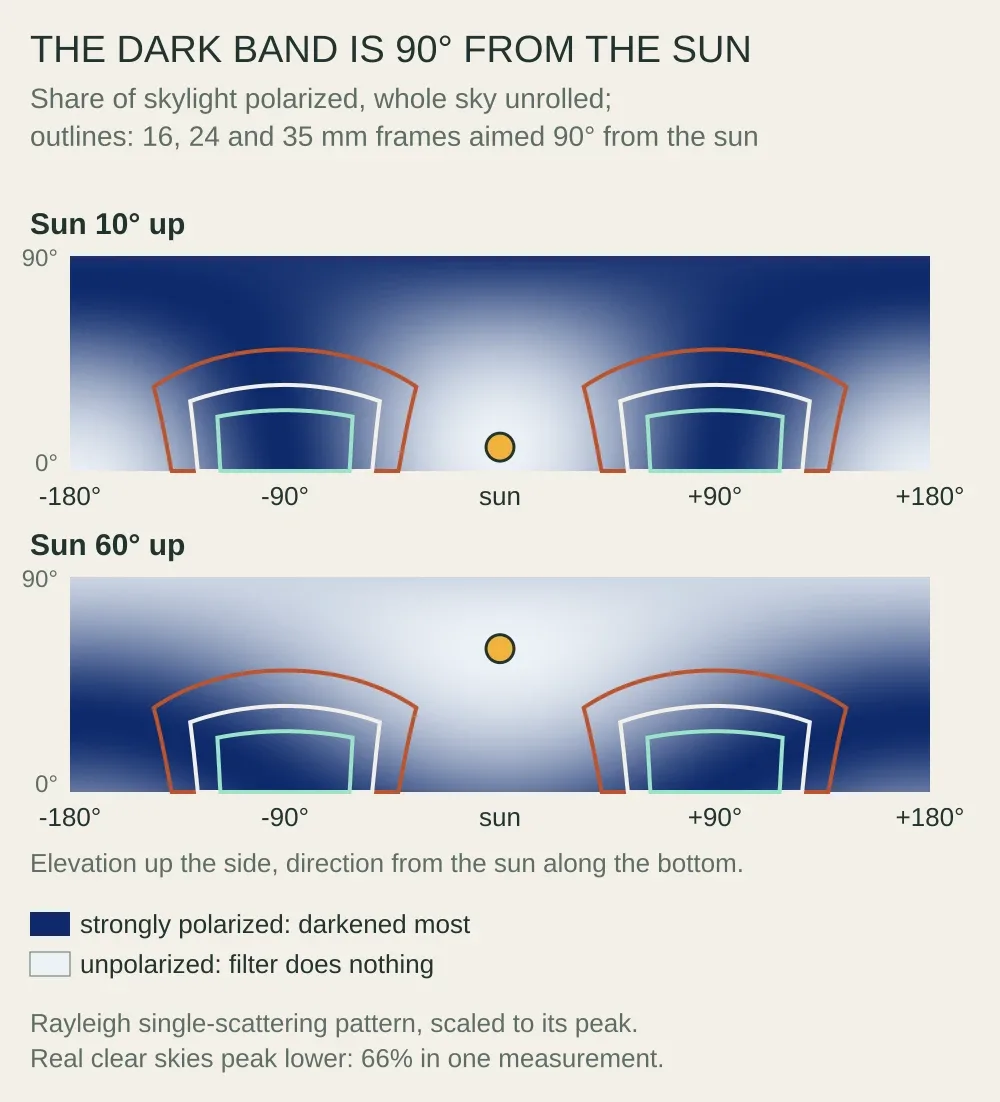
Calculated by Afterlight from the single-scattering pattern. The map shows how strongly the sky is polarized relative to its peak, not a photograph.
To find the band in the field, point your index finger at the sun and stick your thumb out at a right angle. Twist your hand around your index finger: everywhere your thumb points lies on the band. Facing a low sun, the band rises from the horizon on your left, passes over your head and comes down on your right. As the sun climbs, the band tilts toward the horizon on the side away from the sun. With the sun 60° up, it crosses the sky 30° above the horizon opposite the sun and meets the horizon at right angles to the sun's direction.
How wide is too wide for a polarizer?
No focal length is safe and none is hopeless: the band's depth falls steadily as the frame narrows. Afterlight calculated it for a clear sky with 65% peak polarization, a landscape frame with the horizon a third of the way up, and the filter turned for the darkest sky. Each figure below is the gap between the most and least darkened sky in the frame, with the camera aimed 90° from the sun, where the band runs through the middle of the frame:
| Full-frame focal length | Roughly on APS-C | Sun 10° up | Sun 60° up |
|---|---|---|---|
| 14 mm | 9 mm | 1.3 stops | 1.4 stops |
| 16 mm | 10–11 mm | 1.3 stops | 1.4 stops |
| 20 mm | 12–13 mm | 1.2 stops | 1.3 stops |
| 24 mm | 15–16 mm | 1.1 stops | 1.2 stops |
| 28 mm | 17–19 mm | 0.9 stops | 1.1 stops |
| 35 mm | 22–23 mm | 0.8 stops | 0.9 stops |
| 50 mm | 31–33 mm | 0.6 stops | 0.6 stops |
| 85 mm | 53–57 mm | 0.3 stops | 0.3 stops |
The APS-C column divides by 1.5, or 1.6 for Canon; on Micro Four Thirds, divide by 2. A smaller sensor records a narrower field of view from the same lens, and the field of view is what decides how much sky, and so how much of the band, the frame takes in.
Aimed 90° from the sun is the direction where a longer lens helps most, because the band sits in the middle of the frame and a narrower view stays inside it. Aimed partway round, the frame sits on the slope beside the band, and a longer lens shortens that slope much less. With the sun 10° up, aimed 60° from it, the gap is 1.3 stops at 35 mm and 1.1 at 50 mm; aimed 135° from it, 1.3 and 0.9. A longer lens shrinks a band, but not the steady darkening that rises away from the sun.
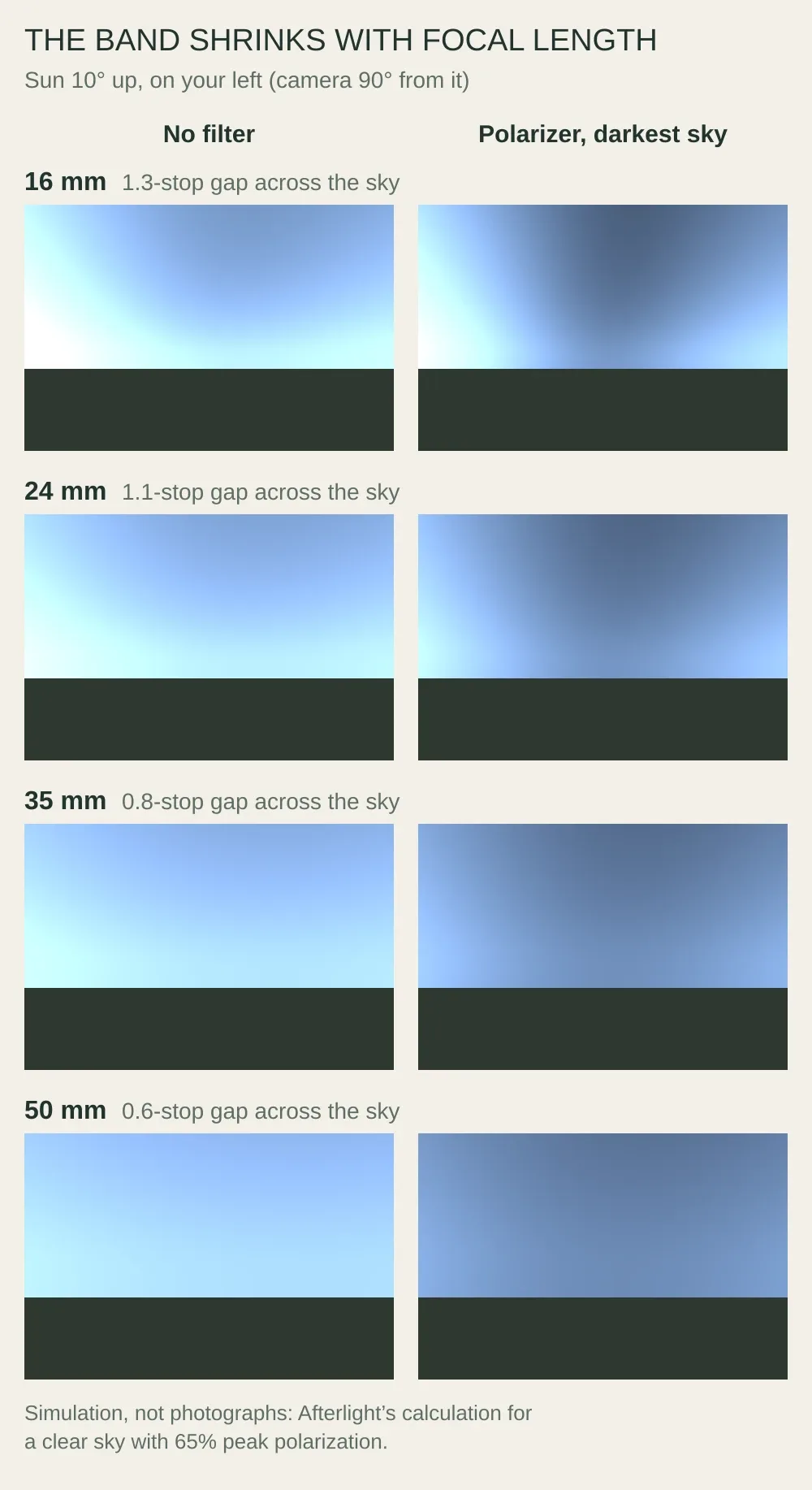
Simulation, not photographs: sky brightness from the CIE standard clear sky, with the polarizer applied by Afterlight's calculation. Ground is shown as a plain dark area.
In these simulated frames the band is conspicuous at 16 and 24 mm, still visible at 35 mm and hard to pick out at 50 mm. That matches the common forum advice to be wary wider than about 24 or 28 mm, but the line is not fixed. It moves with the air. Clouds, and even haze too thin to see, lower the sky's polarization: Nathan Pust and Joseph Shaw at Montana State University found clear-sky polarization dropping hours before clouds became visible. In a hypothetical hazier sky with 40% peak polarization, the 24 mm band would be about half a stop. Where the sky is more polarized than the 65% assumed here (the same team measured higher peaks in green and red light than in blue), the band gets deeper. The same filter on the same lens can look fine one afternoon and blotchy the next.
Where the dark band falls in the frame
Where the band lands depends on which way you face and how high the sun is. These six simulated frames use the same 16 mm lens with the filter turned for the darkest sky:
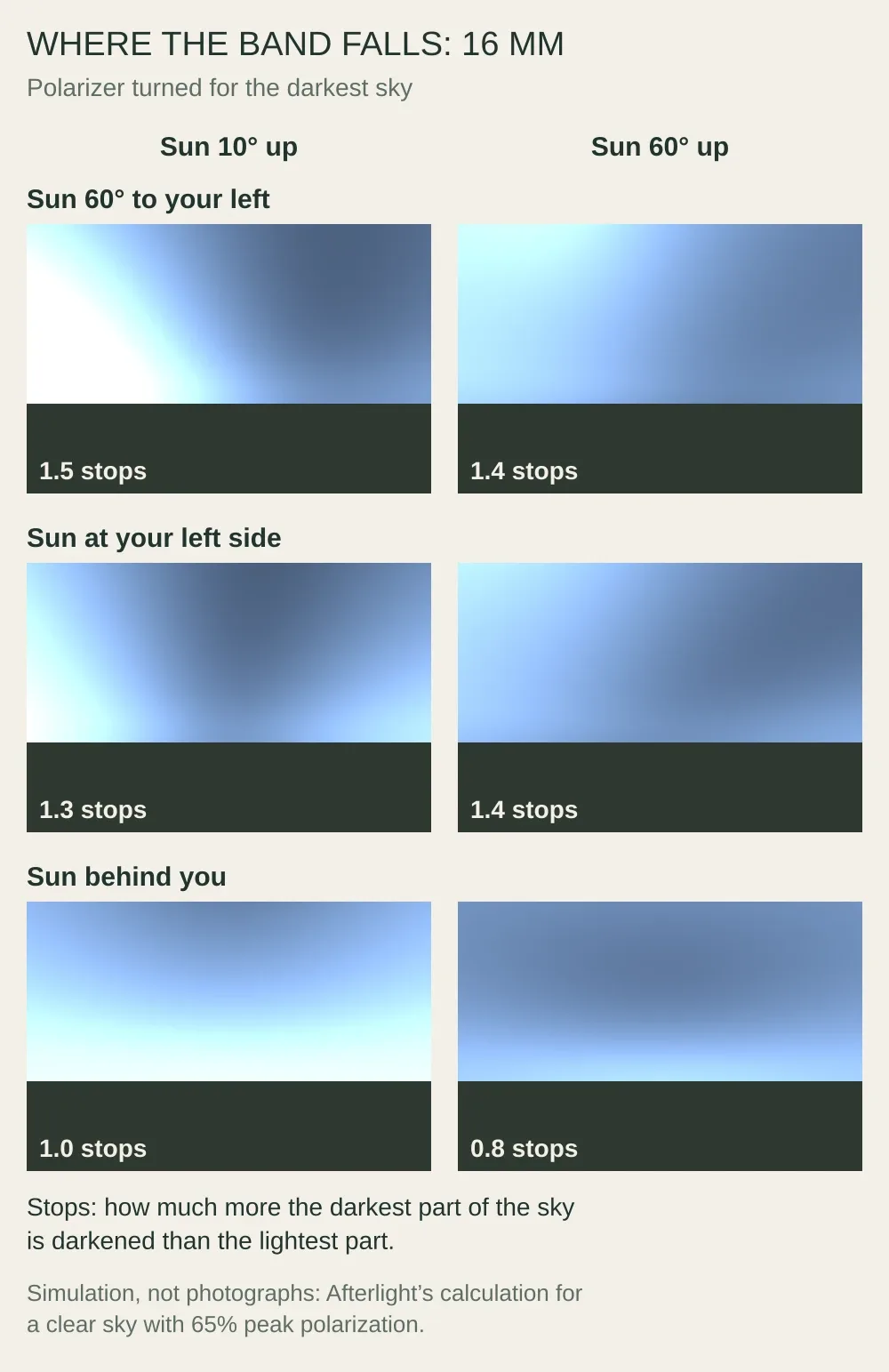
Simulation, not photographs, made the same way as the focal-length comparison.
- Sun at your side, low. The band stands upright in the middle of the frame and runs to the top. This is the classic dark column with paler sky on both sides, and it is where the filter darkens the sky most on average.
- Sun at your side, high. The band tilts across the frame as a diagonal, because at that sun height it slopes down to meet the horizon straight ahead of you.
- Sun ahead and to one side, about 60° from where you face. The frame sits on one side of the band, so the sky grows steadily darker away from the sun. A wide lens takes in the band itself on the far side of the frame. A longer lens sees only the slope, and the slope is steep: at 85 mm, aimed 60° from a low sun, Afterlight's calculation still puts about 0.7 stops between one side of the frame and the other. It looks more natural than a band because the sky already gets darker away from the sun, but it is the same effect.
- Sun behind you, low. The point opposite the sun is just below the horizon in front of you, so the lower sky hardly changes. The top of a wide frame reaches up toward the band and darkens. At 16 mm the filter darkens this sky by only about 0.1 stops on average, yet it still puts about a stop of difference across it.
- Sun behind you, high. The band crosses the frame as a horizontal stripe partway up the sky. This is where the common advice that pointing straight away from the sun is safe goes wrong: with the sun 60° up, the filter darkens this sky by about 1.2 stops on average at 16 mm, with a 0.8-stop gap between the stripe and the lightest sky.
Turning the filter moves the darkest patch along the band but never off it, because only strongly polarized sky can be darkened that much. With the sun low and at your side, the polarization runs the same way all along the upright band, so turning the filter lightens the whole band and the darkest patch stays in the middle. With a tilted or horizontal band, the direction of polarization changes along it, and turning the filter slides the dark patch from one end of the band toward the other.
How to avoid the dark band
Check where the band is before you set up. Use the hand rule, then decide what the filter is for. With a low sun, facing the sun or putting it behind you keeps the band itself out of most of a wide frame, but those are also the directions where the filter darkens the sky least: at 16 mm with the sun 10° up, by about 0.1 stops or less on average, while still leaving a gradient of about 0.7 to 1 stop across the sky. You cannot have a deep, even sky from a wide lens on a clear day; you can choose a deep sky with a band, or a lightly darkened sky with a milder gradient.
Use a longer focal length, or crop. The table above is the trade. Aimed 90° from the sun, going from 24 mm to 50 mm, about half the angle of view, roughly halves the band's depth, and in the simulated frames the band that is obvious at 16 mm is hard to see at 50 mm.
Turn the filter back, knowing what it costs. Rotating away from maximum makes the band shallower, but it takes the darkening away faster. At 16 mm with a low sun at your side, turning 30° from maximum cuts the band from 1.3 to 0.8 stops while the average darkening of the sky falls from 0.8 to 0.3 stops. At 45° the filter no longer darkens the sky on average at all, yet parts of the sky still come out darker and others lighter, 0.5 stops apart. Backing off works best when you only wanted a hint of polarization, or when the filter is there for reflections on water and leaves rather than for the sky.
Do not expect a stitched panorama to fix it. The band is in the sky, so any picture that covers that much sky shows it. Afterlight compared a single 16 mm frame with a row of 50 mm frames covering the same view, the filter set once and left alone: along a line 20° above the horizon, the stitched darkening was within 0.15 stops of the single frame at every point checked. Re-setting the filter for the darkest sky in each frame gives the same band again.
Take the filter off for the sky. A polarizer earns its place on reflections and glare on water and foliage; the sky is where a wide lens shows its limits. If you need both, take one frame with the filter for the foreground and one without for the sky and blend them, or darken the sky afterward with a graduated or brushed adjustment. The band is smooth and follows the hand rule, so a broad adjustment matched to it is usually enough.
How this answer was made: AI-assisted desk research using published all-sky polarization measurements and the CIE standard clear-sky model. Afterlight calculated every band depth, map and simulated frame with a single-scattering model of sky polarization, scaled to 65% at its peak, and an ideal polarizer; the method and code are in Afterlight's test library. Single scattering ignores the light scattered more than once, which lowers polarization, and it is least reliable near the horizon and the neutral points. The figures show the pattern, not exact values for a given day. Afterlight did not photograph these skies for this answer.
← All answersAfterlight