Answers / Camera Basics
Do UV filters reduce image quality?
Desk-researched answer
Short answer
A good multicoated filter does not measurably reduce sharpness on most lenses: Lensrentals found no change in MTF with one on a Canon 50mm f/1.2 and a Zeiss 135mm, though on long, fast telephotos even a good filter can soften slightly. It does add two flat glass surfaces, and those can put a ghost of any bright light at the mirror-image point on the other side of the frame's centre, most visibly at night. A cheap filter can do real harm, softening and flaring the whole image. On a digital camera the UV blocking itself does nothing useful, because the sensor's own filter already stops ultraviolet. Keep a good one on where it completes a lens's weather sealing or the front element faces sand, spray or mud; take it off for night scenes with bright lights, shots into the sun and critical work with long, fast lenses.
A UV filter on a digital camera is a clear window
UV filters were made for film. Film recorded ultraviolet as blue, which added to the haze and blue cast in distant, high-altitude and snow scenes; a mid-century cinematography manual describes how "ultraviolet records as blue on the film" and recommends the Kodak Wratten 1A skylight filter for colour film in open shade under a blue sky (Offenhauser, 16-mm Sound Motion Pictures).
A digital sensor sits behind its own UV and infrared blocking filter. Kolari Vision compiled the sensor filter curves of 82 cameras and found that Nikon, Fujifilm and Pentax cut at around 420 nm, Canon at 416 nm and Sony at 409 nm (Kolari Vision). A typical UV filter cuts lower than that. B+W's own data for its 010 UV-Haze MRC filter shows 50% transmission at about 369 nm, only about five nanometres above its plain 007 Clear filter (B+W protection filters). By the time light reaches the wavelengths a UV filter blocks, the camera has already blocked them. In Kolari's words, this "effectively makes your UV filter a clear piece of glass."
There are two small exceptions. Some early digital cameras, such as the Canon 300D and Nikon D40, let noticeably more ultraviolet through (Kolari Vision), so on those bodies a UV filter can still do some of its old job. And a few sharp-cut filters reach much higher; Hoya's chart for its HD nano Mk II UV crosses 50% transmission at about 410 nm (Hoya). Kolari suggests a filter cutting near 420 nm "could help on Sony or Canon cameras," whose built-in filters are slightly weaker. Even then, it trims the violet end of what the sensor sees; it does not clear haze.
The haze you see in a landscape is visible light scattered by air and particles, recorded at wavelengths every UV filter passes (NASA Goddard lecture notes on Rayleigh and Mie scattering). A UV filter will not clear it on a digital camera, whatever the packaging says.
Good UV filters rarely reduce sharpness, except on long lenses
A flat, parallel sheet of glass in front of a lens does not bend the image. Lensrentals measured this directly. With a high-quality UV filter on a Canon 50mm f/1.2L, Roger Cicala reported "no effects on MTF from the filter, either on or off axis" (Lensrentals, 2016). A B+W multicoated clear filter on a Zeiss Batis 135mm f/2.8 "made absolutely no MTF difference" (Lensrentals, 2017). In a larger 2017 test, most of the filters Lensrentals imaged through a 70-200mm at 200mm showed no significant effect (Lensrentals, 2017).
Long, fast lenses are the exception to watch. A filter that is not perfectly flat acts as a very weak lens: it tilts parts of the incoming light by a tiny angle, and the image moves by that angle multiplied by the focal length. A long lens magnifies the error, and a wide aperture sends light through nearly the whole filter, so any uneven patch gets used. Lensrentals saw this: even a high-quality filter caused "a bit of blurring" of its test pinholes on a 70-200mm at 200mm, because "longer lenses are more sensitive to filters" (Lensrentals, May 2017), and the effects of bad filters at 200mm were less severe at 70mm (Lensrentals, June 2017). Roger N. Clark found that a high-quality Hoya HMC Super UV(0) softened Moon photographs on a 300mm f/4, concluding that "even high quality filters can not deliver the optical quality needed on large aperture telephoto lenses," while the same filter made "essentially no difference" on a 20mm at f/8 (Clarkvision).
Cheap UV filters can soften the whole frame
A poor filter can cost more than any of the above. In one case, a Canon 17-55mm f/2.8 sent back as soft resolved about 14 line pairs on Lensrentals' chart instead of the expected 20; it recovered fully once the renter's cheap filter came off (Lensrentals, 2010). In another, a renter returned a 70-200mm f/2.8 "because it suddenly got soft"; their protective filter turned the lens's pinhole test points into "glaring star flare thingies," and Lensrentals could not tell whether it was a counterfeit or simply a cheap filter (Lensrentals, May 2017).
Light loss shows the gap. In Lensrentals' 2017 laser measurements, the best filters lost 0.1–0.6% of the light, while Tiffen Clear, Chiaro 90 and Tiffen Digital Ultra Clear lost 8.6–9.9%, about what two uncoated glass surfaces reflect. Lensrentals saw "a very obvious break" between filters losing about 0.5% or less and those losing 1.3% or more (Lensrentals, June 2017). LensTip's spectrophotometer test found its weakest UV filters "no better than good quality window glass" (LensTip, 2009); the worst, a basic Tiffen UV, passed 88.3% of visible light and scored zero for flare in every test scene (LensTip, Tiffen 72mm UV).
Price is not a guarantee. In the same 2017 test, a $20 Hoya HMC passed, while a $100 Chiaro had a "significant adverse effect" on the pinhole image despite its good transmission. A discount ultra-thin filter can even touch and scratch a bulging front element, which Lensrentals proved on a Canon 24-70mm f/2.8L II (Lensrentals, 2013).
Every flat filter can add a ghost of bright lights
The cost even a good filter carries is a reflection, not a loss of sharpness. A sensor reflects some of the light that reaches it; Zeiss puts typical sensor reflectance at about 5% (Zeiss technical article on reflections). That light travels back out through the lens. Most reflections off curved lens surfaces return out of focus and spread thin, but a filter's surfaces are flat and square to the lens, so they send part of it straight back, and the lens focuses it into a small, sharp copy of the light source. B+W names the same effect, saying its multicoating means "ghost or double images, which can be caused by back-reflection from the image sensor, are attenuated many times and, depending on the shooting situation, completely eliminated" (Schneider-Kreuznach coating systems). The arithmetic below shows why "depending on the shooting situation" carries the weight.
That ghost appears on the line from the light through the centre of the frame, the same distance out on the other side. A streetlight in the top left produces a dot in the bottom right. It is easiest to see at night, with the lens focused far away, when a small bright light sits against a dark sky.
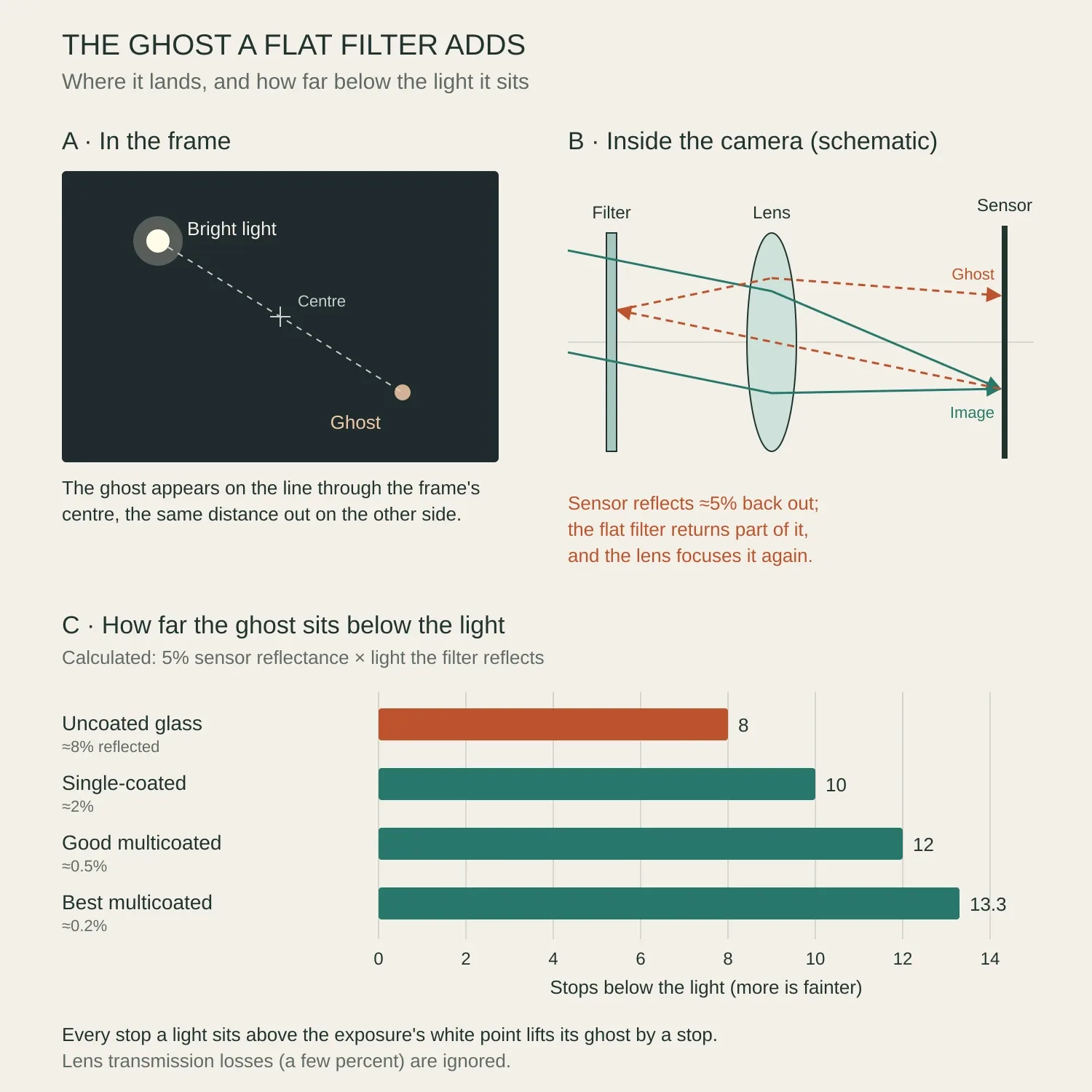
Original diagram. Part B is a schematic, not to scale. Part C is calculated from Zeiss's 5% sensor reflectance and the total light each class of filter reflects.
The ghost's brightness is the sensor's reflectance times the filter's. For a good multicoated filter reflecting 0.5% in total, that is 5% × 0.5% = 1/4,000 of the light, or 12 stops below the source. An uncoated filter reflecting about 8% (4% per surface, B+W's figure) leaves the ghost only 8 stops down, and a single-coated one at about 2% (Zeiss assumes about 1% per surface) leaves it 10 stops down. Twelve stops sounds like plenty until you remember that a bare streetlight is far brighter than the white point of a night exposure: expose so the street looks right, and the lamp itself is clipped many stops over. Every stop the light sits above that white point lifts its ghost by a stop:
| Light above the white point | Ghost, uncoated filter (8 stops down) | Ghost, good multicoated (12 stops down) | Ghost, best multicoated (13.3 stops down) |
|---|---|---|---|
| 6 stops | 2 stops below white | 6 stops below white | 7.3 stops below white |
| 10 stops | 2 stops above white, clipped | 2 stops below white | 3.3 stops below white |
| 14 stops | 6 stops above white, clipped | 2 stops above white, clipped | 0.7 stops above white, clipped |
Hypothetical light levels, for illustration. A ghost several stops below white is still visible against a sky that is darker still.
A better coating moves the ghost about five stops fainter, from uncoated to the best multicoated, which turns a glaring blob into a faint dot in many scenes. It cannot remove it. Lensrentals makes the same point about its no-MTF-change result: it "doesn't mean there might not be a bit of ghosting if you're shooting street lights at night" (Lensrentals, 2016). Taking the filter off removes this ghost; the lens's own reflections stay.
How to test your own UV filter
Two quick checks on a tripod tell you whether your filter is costing anything with your lens.
- Ghost check. At night, frame a distant bright light, such as a streetlight across the road, about a third of the way from the centre towards a corner. Use the widest aperture, focus at infinity, and take one frame with the filter and one without. Look at the mirror-image point on the other side of the frame's centre. A dot that appears only with the filter is the filter's ghost. Repeat with the light a little further out: on many lenses, light near the edges of the frame strikes the sensor at too steep an angle to reflect back through the lens, so a single test near a corner can miss a ghost that shows closer in (Zeiss).
- Sharpness check. Use your longest focal length at its widest aperture, aimed at something flat and detailed. Focus manually with magnified live view, take three frames with the filter, refocusing each time, then three without. Compare the centre and one corner at 100%. Refocusing for every frame matters: a filter that is not flat can shift focus, and you want to know whether the lens can still reach full sharpness through it.
If the two sets look the same, the filter is not costing you sharpness on that lens. Repeat on your longest lens before trusting it on all of them.
When a UV filter is worth keeping on
Keep a good one on when it completes the lens's weather sealing. Some lenses whose front element moves need one. Canon's manual for the EF 16-35mm f/2.8L II says the front element moves when zooming, calls for a Canon PROTECT filter, and adds "Without a filter, the lens is not dust or water resistant" (Canon instruction manual), and the EF 50mm f/1.2L manual says the same about its front element moving when focusing (Canon instruction manual). Fujifilm says the X100VI is weather resistant only with its AR-X100 adapter ring and PRF-49 filter attached (Fujifilm). Check your own lens's manual.
A filter also earns its place where something will hit or coat the front element: blowing sand, sea spray, mud, rain, or anywhere you would rather wipe and replace a filter than a lens. Cicala called a filter "probably worthwhile" around dust, sand or water (Lensrentals, 2016).
Against drops and knocks, the evidence is weaker. In Steve Perry's drop-rig test, which dropped a shuttle onto the front of older budget lenses such as a Canon 35-70mm and a Sigma 75-300mm, every filter broke by 24 inches, while "No lens broke or was damaged in any way with the unweighted shuttle at any height" (Backcountry Gallery, 2015). Against that, Thom Hogan, in a reader comment on a 2017 Lensrentals post, reported seeing shattered filters scratch front elements in the field; that is an anecdote, not a test. A lens hood is the better bumper; Cicala found a mounted hood "provides plenty" of protection for most lenses, wide angles with shallow hoods being the exception (Lensrentals, 2016).
Scratches also matter less than many people fear. When Lensrentals compared scratched and clean copies of a Canon 16-35mm and 24-70mm, "both lenses performed near equally to their undamaged brethren," with the damage showing mainly when shooting into light (Lensrentals, 2022). The real cost is money: Cicala estimated "even a minor scratch is probably a 10% price reduction" on resale, and the replacement front elements he priced in 2016 ran from about $200 for common zooms to $900–1,500 for a Zeiss Otus (Lensrentals, 2016).
Take the filter off for night scenes with lights in the frame, for shots into the sun, and for critical work with long, fast lenses. Leave it off entirely if you never shoot where the front element is at risk; a hood does more for most everyday photography.
How to choose a UV filter if you use one
- Buy for coating and flatness, not ultraviolet. A "clear" or "protector" filter does the same job on digital. Look for a multicoated filter that reflects no more than about 0.5% in total. Lensrentals' 2017 shortlist was the Hoya HMC, Hoya HD, B+W MRC Clear, B+W MRC Nano, Marumi Exus, Canon Protect, Nikon NC, Zeiss T* and Heliopan SH-PMC, tested from one sample each. Models change, so check a current test before buying.
- Buy from a reputable seller. Lensrentals warns that disreputable sellers can pass off cheap filters in a better model's packaging (Lensrentals, May 2017).
- Avoid discount ultra-thin filters on lenses with a bulging front element.
- Use one filter, never a stack. Every extra pair of surfaces adds another reflection.
How this answer was made
This Answer is desk-researched. It rests on Lensrentals' published bench tests and repair observations (2010–2022), LensTip's 2009 spectrophotometer test of UV filters, Roger N. Clark's filter tests, Kolari Vision's compiled sensor filter curves, manufacturer data from B+W, Hoya and Fujifilm, Canon's lens manuals, Steve Perry's drop test, and Zeiss's technical article on lens reflections. Afterlight did not test any filter or lens for this page. The ghost diagram and table are calculated from Zeiss's 5% sensor reflectance and the reflection figures above, ignoring the few percent the lens itself absorbs. Lensrentals' "reflection" figures are light not transmitted at one laser wavelength, so they slightly overstate reflection; the light levels in the table are hypothetical. Research and writing were AI-assisted.
← All answersAfterlight